
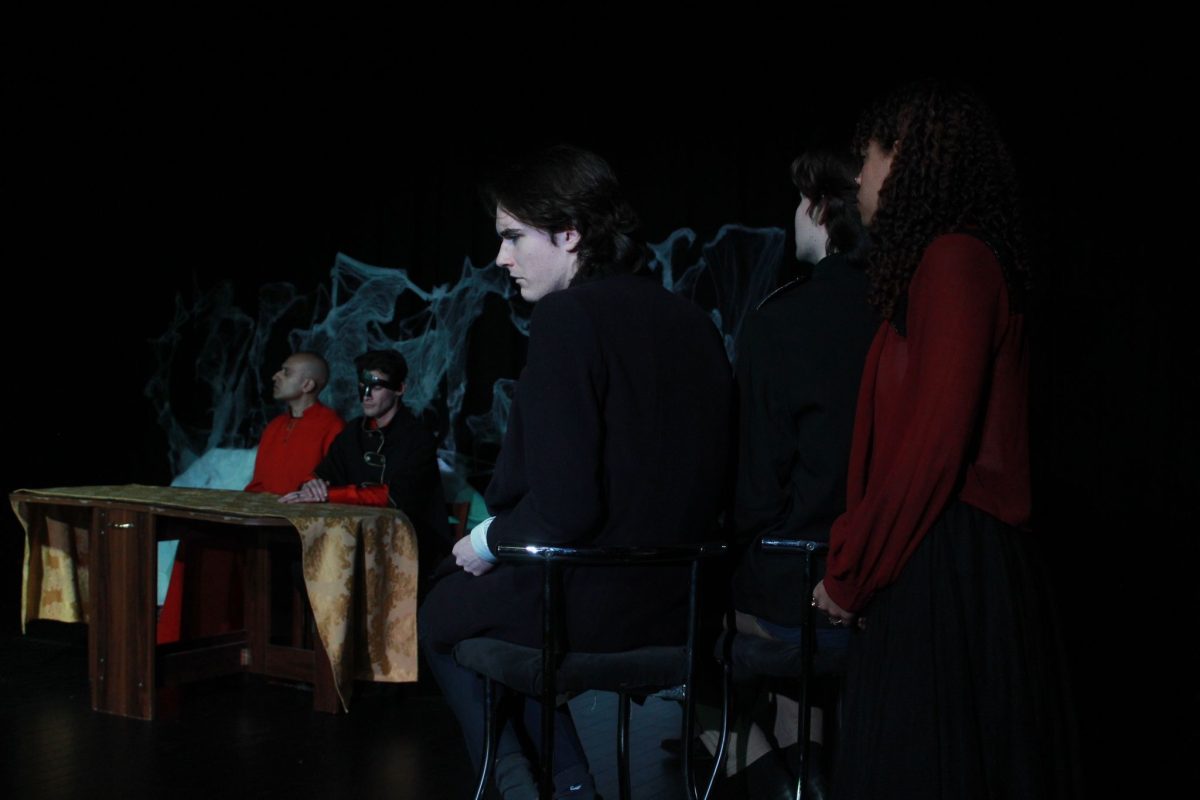
If you think your family tree is complicated, you haven’t tried to keep track of the complicated web of relations that is John Webster’s 1612 revenge tragedy The White Devil. ‘John Webster’s not exactly straightforward…’ one knowing audience member noted during the intermission, as we collected our programmes and attempted to clarify just who exactly was related to whom. In what was nonetheless an engaging show, Matthew Mair and Lara Machado’s production is a little hampered by the original text in the moments where it avoids confronting its hurdles.
The White Devil centres around the affair between Vittoria (Fiona Bestrova) and the Duke of Brachiano (Ben Murphy), who are married to Camillo (Nikolas Haarhoff-Nargi) and Isabella (Izzy Goldberg) respectively. They are brought together by the machinations of Brachiona’s secretary, who also happens to be Vittoria’s brother, Flamineo (Xander Lewis), as he seeks to raise his own station. In pursuit of this, Brachiona and Flamineo attempt to have Isabella and Camillo murdered so the lovers may be together, the catalyst for a string of tit-for-tat murders for the rest of the play.
An ambitious play to perform, there is a sense of genuine love of the play amongst the cast and crew. Coming in at a little over three hours, it is not a play performed very often, and so the choice of it was clearly one of deliberate passion and interest. The directors are also doubling up as set and costume designers, this depth of involvement suggesting a strongly held vision from the pair. A collaboration between 2046 and Analogia Productions, I fully credit what is still the relatively rare move of cross-production collaboration in the Oxford drama scene. It is that shared love for the play that allows its best moments to be so effective.
Opening night jitters dominated the first hour or so, which led to some rather stilted delivery. Like a lot of early modern drama, the opening was admittedly rather exposition heavy anyway, but some rather dry material was further affected in its delivery. Additionally, Isabella’s actress was unfortunately unable to perform due to an emergency; her stand-in had two hours notice, and delivered an admirable performance given her lack of time, but I nonetheless imagine this only added to collective stress. However, the play picked up as the actors’ confidence did, and I particularly found myself enjoying Xander Lewis’ Flamineo more as the play progressed. Driven by the often less-than-sympathetic motive of money, his justification speech was nonetheless engaging as Lewis’ delivered some of Webster’s best lines well (or perhaps his description of graduating to a disappointing job tugged on my Finalist heartstrings more than expected). Taking advantage of the Auditorium’s strangely smooth flooring, he literally slid across the stage at times, capturing the position between comedy and threat that Flamineo occupies to great effect. He was the source of most of the first half’s laughter, and rightly so.
I would be remiss in going much further, however, without describing the sheer delight that was the costumes. There is limited guidance for the audience to follow an admittedly convoluted diagram of interpersonal relations, but this is helped by some delightful eccentric outfits that make confusing characters (even in a play with several double-casts and disguises) impossible. Dismissing the faux-Renaissance dull colours and same-ish shirts that many early modern productions seem inexplicably bound to, we are instead treated to gold-shirted Branchiano, a Vittario adorned in three different but all fabulous gowns, a Phantom of the Opera mask for Isabella’s brother Franscico (Maximillian Stecher), and an iconically cowboy boot clad Count Lodovico (Toby Bruce). Full credit to Machado: the costumes are a clear highlight.
The standout performance of the whole experience was the climax of the first half, the trial scene. With both Isabella and Camillo dead, Vittaria is put on trial by Camillo’s uncle, Cardinal Monticelso (Ali Khan) and Franscico. It is in this scene that the aforementioned love of the play flickering behind most of the performance came out, and that Bestrova’s performance truly shone. Her Vittoria is defiant and despairing all at once, shouting with alluring command. While one of the strongest performances throughout anyway, in this moment her talent was shown to its full extent.
Ali Khan’s Monticelso is another very strong performance, and despite only really appearing in the first half of the play, is the character I remembered most clearly. His delivery of Webster’s ‘What are whores!’ speech at the trial was incredible to watch, combining ever-rising volume with an emotional range that was enthralling to watch. Accompanying him was sound designer Tomas Overton’s rising engine sounds that managed to make what I believe were fighter planes enhance the moment rather than take us out of it (given there were few of those in Renaissance Italy). Both he and Vittoria speak to the audience as they present their respective cases, Monticelso’s righteous declaration splintered by Vittoria’s defiant shouts. It was by far the most impactful scene of the play, and a moment where the production was able to capture the strength of the original text.
The play’s second half centres on Flamineo and Franscico, who both delivered strong performances, even if nothing could quite match the engagement of the trial scene. Drawing the play towards its bloody conclusion, Mair and Machado’s foreshadowing set finally revealed its purpose. Up until this point, three chairs covered in white sheets were positioned at the back of the stage surrounded by giant webs that felt vaguely cloud-like in the images I could see in them (at points being a bat, a cross, and a book). The murders of Vittoria, Flamineo, and Vittoria’s servant Zanche (an understated performance from Mayah Savjani) end with their bodies in those chairs, their blood a violent contrast with the white sheets they are wrapped in. Perhaps a rather crude image, but one that suits what is, at its core, a crudely human play. Méryl Vourch’s light design also gets its moment here, painting the stage a vibrant red that further pushed the point home.
Seemingly deliberately, the production chooses not to engage with the gender and race dynamics that sit uncomfortably within it, especially in the death of Zanche. Actions are played straight from the text, without the adjustments or stagecraft many modern productions employ to explore them. Instead, we are offered a largely faithful rendition of a play that, for enthusiasts of early modern theatre and interpersonal revenge, makes for an entertaining evening of vengeance that is light and heavy all at once.
[The White Devil, a production staged by 2046 and Analogia Productions, is running at St John’s College Auditorium, 11th-13th March, 2026]