
The first thing I remember from my experience of watching Red was the smell.
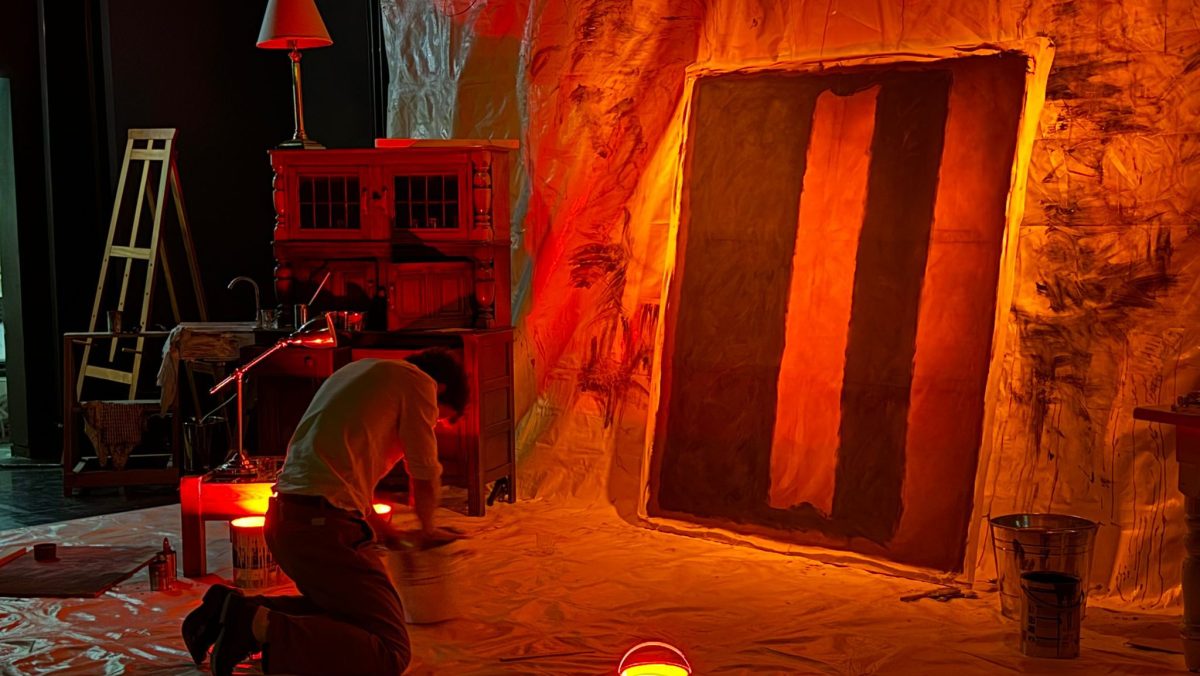
The scent of cigarettes lay heavy in the air. The culprit? Mark Rothko (played by Ollie Gillam), sat pensive in his chair. He gazed upon his studio. The combined efforts of Ezana Betru and Sanaa Pasha (director and producer) bring Rothko’s workspace to life, from the littered paint cans and brushes, to the quaint lamps, and the record player that sits in one corner. And at the centre of it all? One of the Seagram Murals, a presence of red and black that lingers throughout the play both physically and thematically.
John Logan’s 2009 two-handed drama is ostensibly an exploration of the life of the famous abstract expressionist painter, but by taking Rothko’s relationship with his fictional assistant Ken (played by Thalia Kermisch) as its central theme, the play becomes a vehicle to explore deeper themes surrounding the nature and function of art itself – and the high costs of artistic fame.
Riptide Studio, with Betru and Pasha at the helm, compellingly explores these themes. At the centre of it all: Gillam’s Rothko. From the outset, Gillam provides a strong source of tension. Even moments before the play begins, he rises from his seat, and stands, tensed, staring at the Seagram Mural, waiting in anticipation for – something. Once his new assistant arrives for her first day, Gillam comes to life with all of the passion and energy of the frustrated artist. He remains vivacious throughout his opening speech, passionately instructing Kermisch’s Ken to closely examine his painting – but not too close! – and express what she can “see”.
He is, sometimes, a thoroughly dislikeable character – he is abrasive, a little snobbish, even abusive – but Gillam’s performance also renders him an unexpectedly funny one. It was difficult not to laugh at some of his caustic comments. Even a line as cut-throat as “I’m not your father. Your father’s dead, remember?” to the orphaned Ken was so ridiculous and unexpected that (whether intentionally or not) the audience could not help but laugh. While scarcely suppressed frustration is the overarching note of his performance, it is not the only one; towards the end, Ken draws out a deeper vulnerability of the artist, the underlying (and relatable) anxiety of leaving one’s works to the judgements of the anonymous masses. I was lucky enough to have a front-row seat; I could see the subtle softening of Gillam’s facial expressions, conveying the deep sadness that Rothko truly feels.
“Everything here is about me,” Rothko snaps in response to Ken’s complaints that he takes no interest in her life. But in actuality, Red is as much a character study of Rothko’s fictional assistant as it is the man himself. Riptide Studio makes the unique decision to cast Ken as a woman, which undeniably adds another layer to the power dynamic between employer and employee, mentor and mentee. But Kermisch holds her own against Gillam’s intensity, maintaining just as strong a stage presence – at times, even stronger. In a welcome moment of silence from both Rothko and the record-player (which, while charming at first, I do admit became slightly annoying), Ken reminisces upon the bloody memory of her parents’ murder. Rather than a piece of melodrama, there was something powerfully transfixing about her reverie, as Kermisch vividly conjured this deeply traumatic memory through her movements, accentuated by the red paint splattered all over her body after painting a canvas. This moment of tragic quiet was a powerful counterpoint to Rothko’s anger and intensity.
The dynamic between Rothko and Ken lies at the centre of Red’s dramatic potency. It was charming to watch this relationship develop – the transition from Kermisch’s stiff and awkward response to Gillam in the opening scene, to the growing comfort and affection that the artist and assistant feel toward each other. Gillam and Kermisch riff off each other effectively; I think back to their intense debate over the meanings of “red,” and the marked contrast between Rothko’s unrelenting pessimism and Ken’s insistence upon the life and joy that such a simple colour can evoke. I also think back to the moment where the pair work together to prepare a canvas, in record time, to a backing score of classical music. There was something oddly satisfying about their harmony and effectiveness at completing such a simple task; their movements were in perfect co-ordination, speaking to the strong dynamic between Gillam and Kermisch.
Light is a core theme of the play: Rothko is particular, and cannot stand presenting his works in harsh or natural lights. Accordingly, lighting designer Ben Tilley performs some interesting (dare I say artistic?) experiments with the play’s lighting The decision to put LEDs into some of the scattered paint cans was innovative; during Rothko’s frequent breakdowns, these cans glow in a bloody red that accentuate, rather than distract, the mood and energy of the scene in what is otherwise a highly naturalistic production.
As somebody who was not particularly clued-up on Rothko’s life or works , I can confidently say that within an hour and a half, Riptide Studio made me eager to learn more about the man, his life, and times. I have no doubt, too, that Red will strongly appeal to the more artistically-inclined among us. I look forward to seeing what Riptide Studio, and Betru and Pasha’s collaboration, produces next!
[Red, staged by Riptide Studio, is running at Michael Pitch Studio, 3rd-7th February, 2026.]