

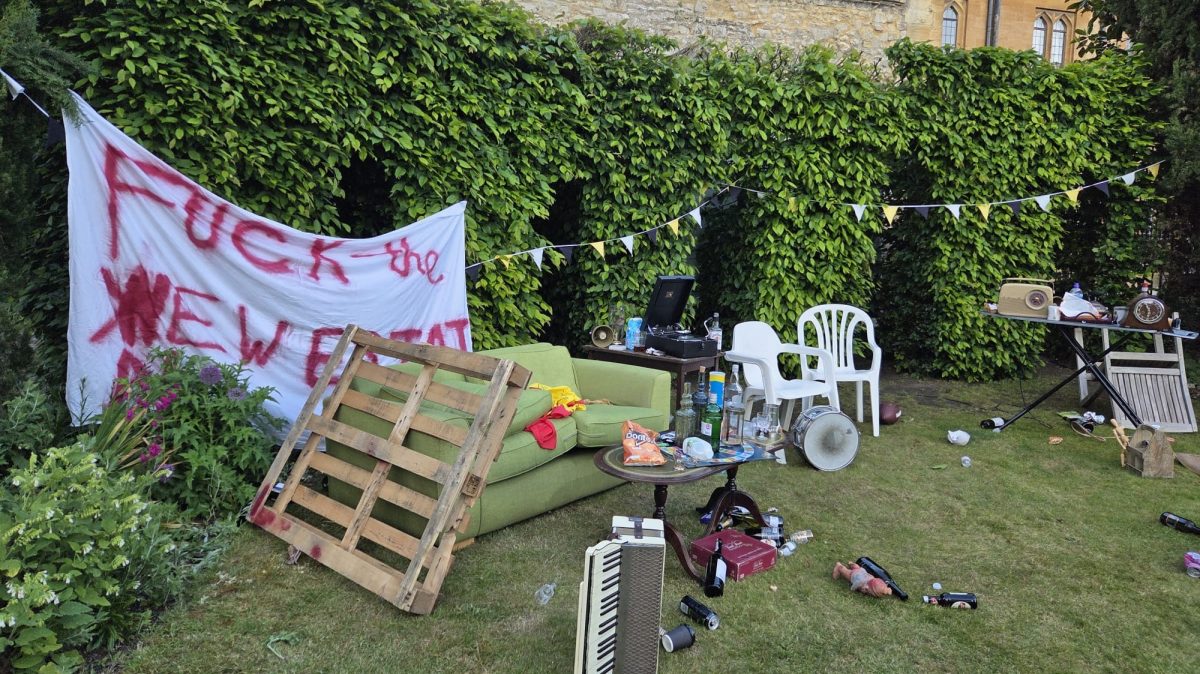
From 19 to 23 May, the quaint President’s Garden at Magdalen College becomes Johnny ‘Rooster’ Byron’s drug den.
I’ve tried to explain what goes on in this play to probably about ten different people, and each time I’ve come up with a very different answer. ‘Jerusalem’ does indeed refer to William Blake’s poem, now known as a patriotic hymn in praise of England. The play as such celebrates some of the most eccentric elements of English tradition. There’s a May Queen, Morris dancing and giants(!), all taking place during the St George’s Day fair in the village of Flintock in the West Country.
This setting, however, doesn’t seem to warrant Jerusalem’s very many content warnings. Phaedra Cox, played by Maisie Thorn, opens the play with a beautiful timbre as she sings the titular hymn. But she stops abruptly after mention of those “dark satanic mills.” It is in this darkness that the play resides, as it takes in the more taboo English traditions of drug-taking, alcoholism, underage sex, and, above all, colourful language.
The play’s unorthodox hero is Johnny Byron, played by Adoloras. Adoloras does excellently to make the foul-mouthed, perpetually-smoking Johnny into someone who we side with against the council’s attempt to evict him from the caravan that squats in the woods opposite a new housing development. In a perfectly-choreographed moment at the start of the play, Johnny stumbles over the many bottles that litter his doorstep, mixing coffee, vodka and a raw egg in a cafetiere, all whilst bumping along to music in a way you can’t help but grin at. This, and Johnny’s penchant for telling hilariously outlandish stories – from being born to a virgin mother, to being abducted by Nigerian traffic wardens, to actually dying and coming back to life – establish him early on as a character that we unexpectedly warm to. In a village where the only other alternatives for teenage drinkers are sitting in the pub or “freezing your bollocks off” in a bus shelter, Johnny’s ramshackle caravan is positively hospitable.
On the subject of the caravan, the set is a sight to behold. A messy sofa – from behind which wannabe globetrotter Lee (Nicholas Crossa) will awaken from a drunken stupor – to the audience’s mirth – faces onto a coffee table littered with cocaine, alcohol and Doritos. A barbecue into which Johnny will dramatically tear up the council’s eviction notice sits stage left, just in front of the ironing board that bears his broken clock and aged radio. The possibilities that the outdoor stage presents are exploited to the greatest extent. Pea (Hannah Suckling) and Tanya (Sanaa Pasha) rush for the flowerbeds to throw up. The jingling of Wesley’s (Alexander Lloyd-Elliott) ridiculous outfit for Morris dancing, which he hilariously insists he was “roped into,” can be heard coming down the garden path. The work of Billy Hearld and Maya Herz on costumes here was top-notch.
Lloyd-Elliott’s performance must be singled out here for his ability to switch seamlessly between comic relief, nostalgic melancholy and intense concern for Johnny’s safety. He demonstrates that no character in Jerusalem is merely a one-dimensional addict; they have emotional depth, too. The entrance of Georgina Cotes as Dawn, mother of Johnny’s son, likewise created a notable shift in tone. The other characters became uneasy, made their excuses, and left, giving Dawn the space to vent her anger at Rooster’s fathering. Jerusalem, though ostensibly a comedy, is never far from moments of real tension.
Troy Whitworth (Billy Hearld), who enters at the end of Act 2, is the clearest example of this. Whilst no character goes more than a sentence without uttering something bleepable, the aggression in Hearld’s delivery serves to demonstrate that he is not just another one of Rooster’s drinking buddies, but a threat. I choose to believe that it was not coincidence, but directorial genius by Hearld and Billy Skiggs, that Troy’s first entrance came just as the skies were darkening. This visibly marked the more serious turn that the play took after the slapstick humour that had the audience rolling to that point.
As magical as Johnny purports to be, there is one thing he could not control – the poor weather, the ultimate English tradition. Come Act 3, lashing rain and light failure meant that my viewing was unfortunately cut short. But the actors deserve great credit for their persistence in the windy conditions up to this point, not least Peregrine Neger as the Professor, dressed in a light blazer and shorts. Neger was given the unenviable task of staring me in the face, completely still, for a good ten minutes in a coked-out daze, before collapsing in a heap on the floor, where he twitched at random. I doubt there’s any other garden plays this term you could write that for.
So, if you want to watch a garden play, but the airy-fairy nature of a Shakespearean comedy just isn’t gritty enough for you, Jerusalem should be your pick. I’d particularly recommend taking along your international friend who’s never left Oxford. It will provide a marvellous induction to English culture – both its bizarre highs, and deepest lows.
[Jerusalem, staged by Magdalen College Drama Society, is running in the Magdalen Gardens, 19th-23rd May, 2026.]