
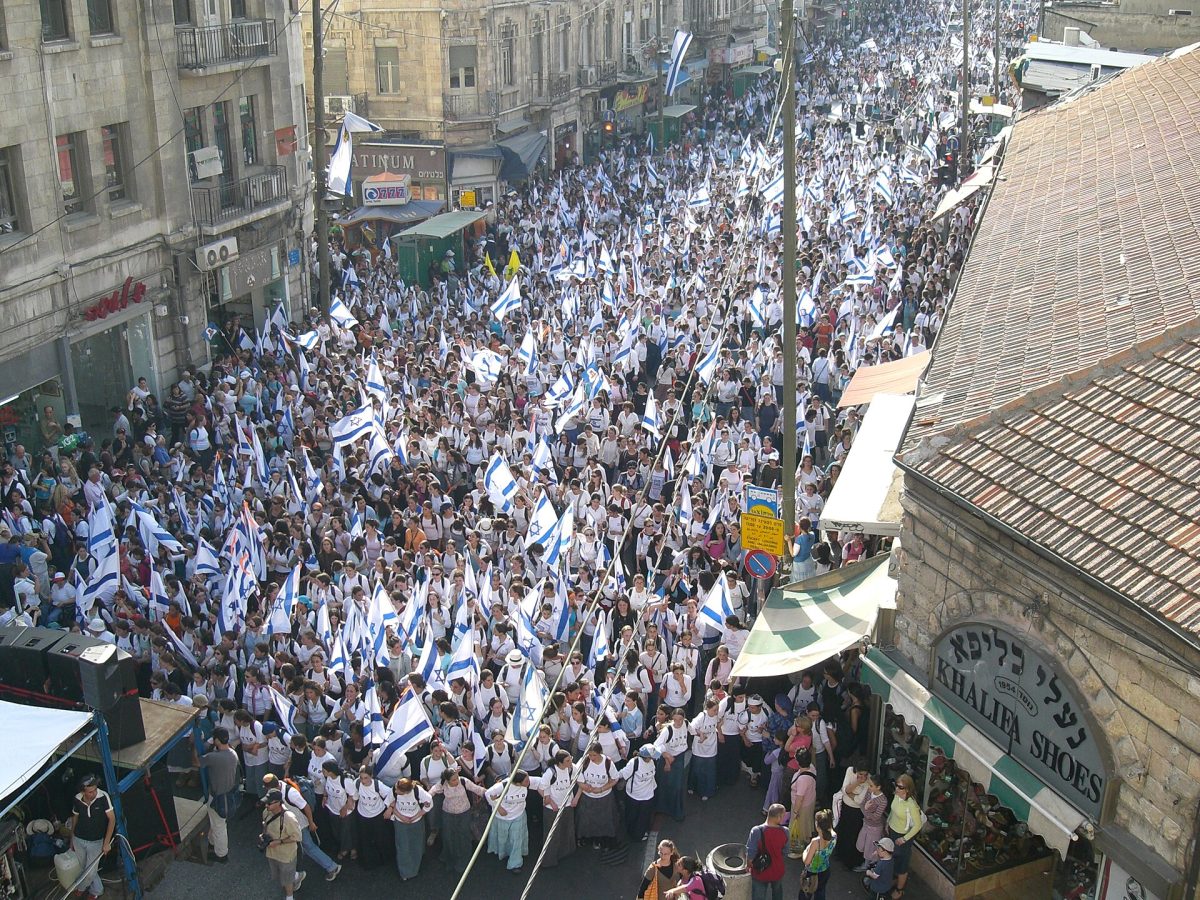
Jerusalem Day is an Israeli national holiday celebrating Israel’s capture and control over Jerusalem after the Six-Day War in 1967. Following Israel’s occupation of Jerusalem, Palestinian inhabitants who were not registered as Israeli citizens, were granted residency but were not allowed to vote in national elections. The annexation of East Jerusalem, which has a predominantly Palestinian population, was illegal under international law. Under the Fourth Geneva Convention, an occupying power cannot gain sovereignty by taking over a territory through military force. This makes Israel’s control over East Jerusalem a military occupation, which is also why it is not recognised by the United Nations. It was then that Israel also established Jerusalem as its undivided capital, even though this was also rejected by the majority of the international community at the time.
In Israel, however, this event is celebrated as it was the first time, since the destruction of the Second Temple in 70 CE, that the entire city came under Jewish rule.
Across Israel, from sunset on 14th May until nightfall on the 15th May, there are street parties, concerts, and public lectures exploring the history and significance of the city. State ceremonies include official memorial services and educational events to honour the IDF soldiers who fought in the 1967 Six-Day War. Religious services include the recitation of the Hallel (prayers of praise and thanksgiving) in synagogues. However, the most prominent annual event is the ‘Dance of Flags’, which is a major traditional flag march where tens of thousands of Israelis parade through the streets of Jerusalem, passing through Palestinian areas, which leads to taunts and attacks against Palestinians, as well as Jewish peace activists. This event alone sheds light on the longer-term patterns of violence and discrimination that Palestinians face on a daily basis.
This violence can also no longer be viewed as an unfortunate by-product of the celebrations. The hostility displayed during the march every single year has become so routine that it now appears to be embedded within the event itself.
While tens of thousands of ultranationalist Israelis across Israel participate in these violent marches, Palestinian residents outside the Old City are not allowed entry into the area by police, and Palestinians living in Eastern Jerusalem have no choice but to barricade themselves indoors in order to shield themselves from violent attacks. On this day, Israeli police force Palestinian shop owners to close, and out of fear of attacks and harassment, most other Palestinian businesses already close for the day. Yet this year, it also did not stop some participants of the march vandalising property, and banging on shops’ closed shutters as they passed. Others clapped, spat at, and hurled insults, and chanted anti-Palestinian slogans as they passed Palestinian residential areas. The most common chants, which repeat every year, include ‘May your village burn’ and ‘Death to Arabs’.
The repetition of these incitements of violence annually remains unchecked. It raises questions about why such forms of racism and incitement are considered politically acceptable within large parts of Israeli society.
The ultranationalist marchers have the full support of the Israeli government, giving the violent behaviour even more legitimacy. Last month, Israeli newspaper Haaretz reported that the government will set aside more than 1 million shekels (£255,714.57) to fund flag marches across the country. Haaretz also referred to the flag marches as a state-sanctioned invitation for ultranationalist groups to enter the Muslim Quarter. This year, they also reported on Israeli ultranationalists smashing shop signs, breaking locks, hitting metal doors with flagpoles, and plastering racist stickers across Palestinian areas of the Old City. At this year’s event, fights broke out even before the march officially began, as many teenage Israelis started by attacking Palestinians in the Christian Quarter.
Itamar Ben-Gvir, National Security Minister, also led a large group of Israelis into the Al-Aqsa Mosque compound (the third-holiest site for Muslims) and displayed the Israeli flag in front of it. The foreign ministry of Jordan condemned the action as a “blatant violation of international law, an unacceptable provocation, and a flagrant breach of the historical and legal status quo”. However, such actions cannot be viewed as isolated provocations, but are part of the broader effort to assert exclusive Israeli sovereignty over religious and national spaces.
Israeli politician Ofer Cassif noted that the event has become more violent in the past few years, but that the Flag March ”has always been a violent event”. Cassif accused Netanyahu’s government of encouraging the violence and described the Israeli police as Ben-Gvir’s “private militia”, which does not stop “the violence, the lynchings, the destruction of shops, the aggression and attacks against Palestinians in the Old City, and throughout the city as a whole”. Journalists who attend to cover the march are also shoved and blocked from filming by participants.
A small number of Israelis attend the flag march in solidarity with Palestinian residents of the area. They too face physical and verbal abuse from marchers. Among them is the activist group Standing Together, an Israeli-Palestinian grassroots movement that deploys volunteers across the Old City to try to shield residents from settler violence and harassment. In addition to Cassif, the Standing Together group’s co-director, Rula Daoud, has also echoed that the flag march is becoming more violent every year. She also accused Israeli police of failing to intervene to stop abuses. She said, “This day, thousands of basically settlers and right-wing fascist young and older people will be roaming the streets chanting very racist things, trying to destroy places owned by Palestinians and just terrorising the whole place”.
On last year’s march, a Reuters witness confirmed that when a Palestinian woman and journalists were spat on by a group of Israeli teenagers, the Israeli police did not intervene. A police officer argued that the marchers could not be arrested because they were under the age of 18. Such explanations however do not reassure anyone whose safety is at risk, especially Palestinians who experience unequal policing whenever they are the targets of violence.
This year, when two Palestinian children were being attacked, the Police only helped to escort the children out of the crowd, all while Israelis on the march continued to shout “get out” at them. This year’s march also saw many participants wearing stickers of Ben Gvir and a noose, a reference to the death penalty bill that he helped pass in the Knesset earlier this year. Settlers also gathered inside Damascus Gate, the main entrance to the Muslim Quarter and Al-Aqsa Mosque.
Despite also facing attacks, Israeli activists continue to join the marches because they argue that a Jewish person being attacked, alongside a Palestinian, is more likely to force the authorities to intervene to break up attacks. Yonatan Shargian, an activist with Standing Together, explained that “Every year there is bullying, verbal hate, and physical violence.” This year, approximately 200 teenagers and men took turns to chant “Death to Arabs” and “A Jew is a soul, an Arab is a son of a whore”. One large banner read “It’s not Al-Aqsa, it’s the Temple Mount. You want a massacre? You’ll get the Nakba”.
The Nakba (Catastrophe) refers to 1948, when an estimated 13,000 Palestinians were killed and 750,000 expelled and forcibly displaced by Zionist and later Israeli militias, in order to make way for Israeli settlers to occupy their homes. Historians describe the Nakba as the ethnic cleansing of Palestine during the creation of Israel. The invocation of the Nakba during these marches is a clear example of how the historical trauma faced by Palestinians continues to be weaponised by some Israelis.
Additionally, this year, the flag march was held a day before Palestinians commemorate the Nakba. For many, the violence waged against Palestinians on Jerusalem Day is a continuation of the violence they already experience on a daily basis.
This year reports also state that the Israeli government intends to change Jerusalem’s boundaries for the first time since East Jerusalem’s annexation in 1967. They intend to expand Israeli control further into Palestinian areas of the occupied West Bank.
However, if we are to only consider the scale of violence that Palestinians are made to endure on Jerusalem Day alone, this Israeli national holiday can no longer be viewed as a mere commemorative event celebrating the (illegal) Israeli capture of Jerusalem. It is instead just one among many events through which the scale of violence and oppression that Palestinians face on a daily basis can be witnessed.