
My work for Lady Grinning Soul has inadvertently branched in two directions: creative conditions before and after the Covid-19 pandemic. Art sectors have become unrecognisable in the past half-decade with the reinvigoration of DIY production, but also with the widespread closures of live music venues and general dematerialisation of the music industry. It is no secret that the pandemic hit global music scenes hard, putting artists at risk and diminishing production across the board. Ireland’s government established their Arts and Culture Taskforce in 2020 with the intention of reversing this impact.
You may have read about the Basic Income for the Arts (BIA) pilot scheme that ran from 2022-2026. 2,000 applicants were granted a stipend of €325 per week to help offset rising costs of living and supplement creative output. Recipients of the stipend have credited the scheme with allowing them to experiment with new mediums, write for independent publications, reach new audiences, and engage more meaningfully with their communities – according to several interviews conducted by The Stinging Fly.
It was recently announced that BIA will become a permanent program starting in 2026. The Irish government plans to open the scheme up to more applicants incrementally.
A government-conducted assessment found that the vast majority of surveyed citizens were in support – over 97% supported making the scheme permanent, and 44% thought that the stipend amount should be increased.
The Irish Department of Culture reports that funding recipients are not the only beneficiaries of the initiative. According to reports following the conclusion of the pilot scheme, for every €1 of public money invested in the pilot, society received €1.39 in return.
I spoke with a Dublin-based band called WineMom to ask about the reality of the BIA scheme. WineMom is composed of Reese Martin (drums), Rosanna Harrington (vocals/ guitar), Matthew Marshall (guitar), and Millie Molony (bass). They met through the Dublin music scene while in college and have just finished the process of recording their first EP.
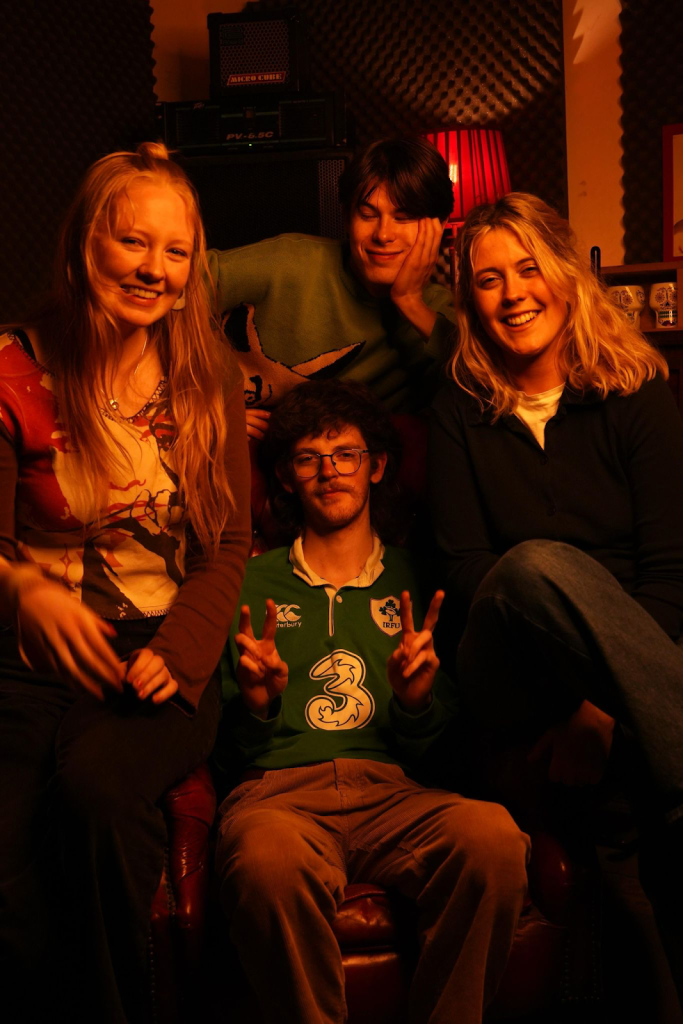
WineMom, courtesy of Niall Rushe, @niallrushemedia, used with permission
Reese told me that everyone knows everyone within the Dublin music scene.
Reese: Even a small gig will always have someone you know working or spectating.
Me: Do you know anyone involved with the BIA scheme? How much talk has there been about it in your community?
Reese: We only really got onto the whole grant scheme buzz last year where we applied for anything that was going. In my opinion, the grants are not accessible for the average artist, there are piles of forms to fill out for really not that much money. I went to my local council to ask for in person advice and I was turned away. In the UK, the artist grant schemes are much more accessible and the grants themselves are very generous. There is a mindset of ‘it’s not what you know, it’s who you know’ in Ireland, which will make it very difficult for up and coming artists to get anywhere. Not many artists I know have successfully got a grant, but I know many who have applied.
Me: What would you do with the extra financial support? Would it change your music, your process, or your day-to-day life? How do you see it benefitting your community, or affecting people outside of the world of music?
Reese: There would be so much I would do. Right now we don’t pay ourselves, so the money just goes back into the band for studio time/petrol for transport. It would be great to cover those costs. It would definitely put a much more professional atmosphere on the studio time, with wanting to use every cent wisely. We would be able to not worry about expenditure and only focus on writing good songs. More grants means more music created which means more gigs and more albums, people will listen to smaller independent artists, go to more underground shows which creates revenue for the venues and the record shops and therefore the community. Ireland has an incredibly rich history of art and music, and it is only ever growing. I believe it is hugely underfunded whilst the city centre is slowly being gentrified, more and more music venues are closing down. It is such a shame.
Me: What are you working on now, and is there anything you’d like to promote? Tell us a little bit about the band, what your music is like, and your hopes for the next year or so!
Reese: As of this week, we have just finished our first EP! We are two guys and two girls who come from all different musical backgrounds but all come together for our love of 60s/70s rock, so we have a very nostalgic sound but we are still inspired by more recent pop and rock artists. Our image is camp and fun but our music is loud and serious. We hope to tour again this year and pick up a few more festivals. Next year I hope to be doing this full time if the government will let me!
Keep up with WineMom on instagram @winemom_official and on Spotify.
Ireland’s BIA scheme isn’t the first of its kind. France originally implemented its régime des salariés intermittents du spectacle (scheme for intermittent workers in the performing arts) in 1936 as a way to bolster the rapidly growing film industry, particularly aimed at crews working under short-term contracts. Salaries are provided to people in creative industries who work a minimum number of hours per year (507 in a 12-month rolling period). In mid-2020 the government invoked an emergency année blanche (blank year) in which the minimum hour requirement was suspended, allowing artists to continue to live with support from the initiative while performance venues were temporarily closed.
Italy’s National Social Security Institute (INPS) allows painters, sculptors, musicians, writers, and drama authors to submit claims in order to support their study and production of art. Germany’s Masterplan Kultur Hessen allocates 6.7 million euros towards the support of freelancers in creative sectors. The Irish BIA scheme is not only precedented: it is vital to the well-being of a nationwide music scene experiencing one of the most distinct renaissances in recent memory.
Creative worker income guarantee schemes don’t just improve the mental and physical well-being of those directly involved. Thriving art scenes are foundational to public health, economic growth, and social advocacy initiatives. Ireland’s cost-benefit analysis is an important step towards justifying the legitimacy of creative worker income guarantee schemes worldwide.
While a formal equivalent of the BIA initiative does not currently exist in the UK, Equity (the trade union for creative professionals) is working to implement a basic income guarantee model. Last month, Equity published a call for evidence detailing barriers to young people entering and surviving in creative industries.
If (like me) you’re interested in learning about how a formal scheme could be implemented in the UK, check out this pilot recommendation published in 2024 by Caldow et al.
Thank you for reading, and thank you to WineMom for the insight. If you have any projects or events to promote, don’t hesitate to reach out at ladygrinningsouloxford@gmail.com.