
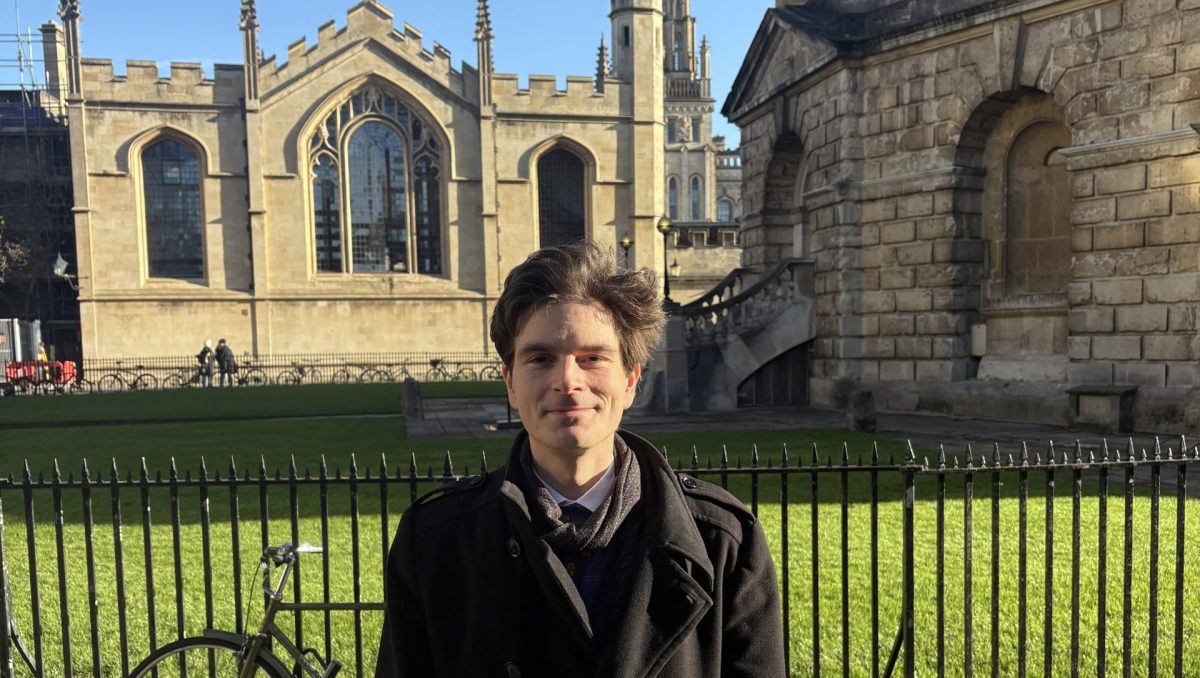
Sitting down in the beautifully engraved pews of Exeter College Chapel, I had the pleasure of listening to a Mozart Overture and Schubert’s 4th Symphony performed by the Turl Street Orchestra in its termly concert. At the head of the student group was their conductor, a bit older, a bit more confident, and noticeably better dressed. As I saw him directing the group, making sure the concert went on without a hitch, I thought, “he’d be a great interview”. And so, here we are!
Dr. Felix Tennie is an Oxford physicist by day, and an orchestra conductor by night. This incredible combo forms his quite impressive character, one I had the pleasure of sitting down with this past Tuesday.
Luke: “I want to ask you a bit about your musical background… Your day job is as a physicist, but you’re also a conductor of an orchestra. That’s quite the duality…”
Felix: “I studied physics and mathematics, but I also studied piano and conducting back in Hanover, Germany. At the end of my course, I had to make a decision and was offered a fully funded PhD, which I accepted.”
Luke: “So you came here to Oxford for physics, then got involved with conducting on the side?”
Felix: “More towards the end of my time as a DPhil student, I strolled around the Fresher’s Fair to see what’s new, and I chatted with one of the members of the Turl Street Orchestra. First I played a piano concerto with them. They were looking for a new conductor, and I said I’d be happy to do that. That’s how the story began!”
Luke: “How long ago was this?”
Felix: “Eight years? At least eight years. I know I’m a dinosaur in that respect! For as long as there is no desire to have someone else, I’m more than happy to continue. It’s a lot of joy and fun for me!”
Luke: “You perform once a term with the Turl Street Orchestra. How do you prepare across the term with a non-auditioning group?”
Felix: “It always takes a bit of fine tuning, especially after the first week of Michaelmas. After that I know what musicians we have and what we need to source. Then I see what my strategy should be, what music we should play, which parts get priority. I try to adapt my planning to the group I have. But there’s always challenges, especially with busy Oxford students. There’s dinners, there’s essays, there’s issues that can simply be put down to not being a professional orchestra. It’s quite a pragmatic approach, it has to be.”
Luke: “I noticed you had about six oboe players this term, an army of them!”
Felix: “Yes! Usually we lack oboes, but this term we had six– extraordinary! We decided for each oboist to cover certain solo parts. That was the broadest strategy. It is a non-auditioning orchestra, so we like to uphold this ethos that we try to incorporate everybody.”
Luke: “So there’s some amount of people management involved in a group like this versus being in a professional orchestra, where you know you’ll have the right balance and everyone can play the part.”
Felix: “The atmosphere is very different. In a professional orchestra, people are meant to sit there because it’s their job. There’s not as much enthusiasm, I think. If you play Beethoven 5th for the 10th time in your life… But when you have students and it’s their first time playing an entire Beethoven symphony, there’s an additional level of enthusiasm. That is highly enjoyable for me! The scope is different. At the risk of sounding pathetic, you can walk out and say, ‘Well, now I’ve played a Beethoven symphony’… It’s a before and after experience. I’ve found this is one of the most rewarding parts of it. When students come back and say, ‘thank you, I’ve learned quite a lot,’ that’s very heartfelt and I feel very grateful to be able to do that.”
Luke: “Do you think there’s something different about Oxford students and their musical capabilities?”
Felix: “The main difference with regards to teaching in Oxford is that the students are around for 8 weeks. That means we have seven weeks to work with the repertoire, which is extremely short. Other universities that operate on a semester system have 12, 13, sometimes 14 weeks and a Christmas break as well to practice. They have fewer concerts, but you get to go deeper into the music.”
Luke: “Do you enjoy the challenge of the rush, that feeling of stress?”
Felix: “I enjoy seeing dramatic improvements over a short period of time. Of course, there are times when I wish that we had a few more rehearsals. But, I think it’s good to have deadlines and you can see that there’s an exponential improvement towards the end when everyone’s getting more and more excited.”
Luke: “You talk about exponential improvements, but have you ever gotten to Week 5 and thought, ‘this is not going to go well’?”
Felix: “It happens to both me and the students. But I always have enough confidence that I can turn the ship around. But sometimes, I think, ‘this is going to be tight!’ But the students feel it as well. If we’re in Week 5 and we are still missing some crucial parts, I mean no one says it, but they take responsibility, practice on their own time, etc.”
Luke: “Do you as a conductor feel that you need to stay calm and try to instill a bit of confidence in the group, especially on concert day?”
Felix: “I believe in the fact that everyone has the skillset to make a very nice concert. And, therefore, I’m not going to shout and lose my head. I hope I never will, and I think I never have. But there’s little things that can happen which cause some disruptions. For example, this year 20 minutes before the concert we realised that there was a screw missing on the timpani! No professional conductor has to deal with that kind of thing. But it all worked out, it always seems to.”
Luke: “How do you think your work in physics impacts your music? How do they interact?”
Felix: “If I had no music, I wouldn’t be as productive of a physicist. Whenever I don’t get to make music for a time, I become a bit exhausted in physics. Having both in my life is interesting. There’s a contrast in the social settings, especially. You will never see a string quartet writing a paper together! It’s fundamentally different.”
Luke: “What is coming next for the Turl Street Orchestra?”
Felix: “We’ll be playing Beethoven’s Eroica next term, which is a huge challenge for us. We had our first reading of the piece last Friday, and the students are really up for the challenge!”