
As modern cinema becomes increasingly commercialised, films are primarily lauded for their entertainment value, a well-known cast of actors and provocative subject matter over form and visual innovation. These trends, which favour fast-paced editing and action-filled plots, might be said to have blunted our capacity for critical observation and undermined our visual literacy. It is more important than ever, therefore, to rediscover older films so that we can understand how what we normally perceive as their technological disadvantages – being black and white, lacking dialogue, or having rudimentary storylines – are, in fact, the very conditions that spurred innovative methods of visual storytelling and which can make us a more receptive modern audience.
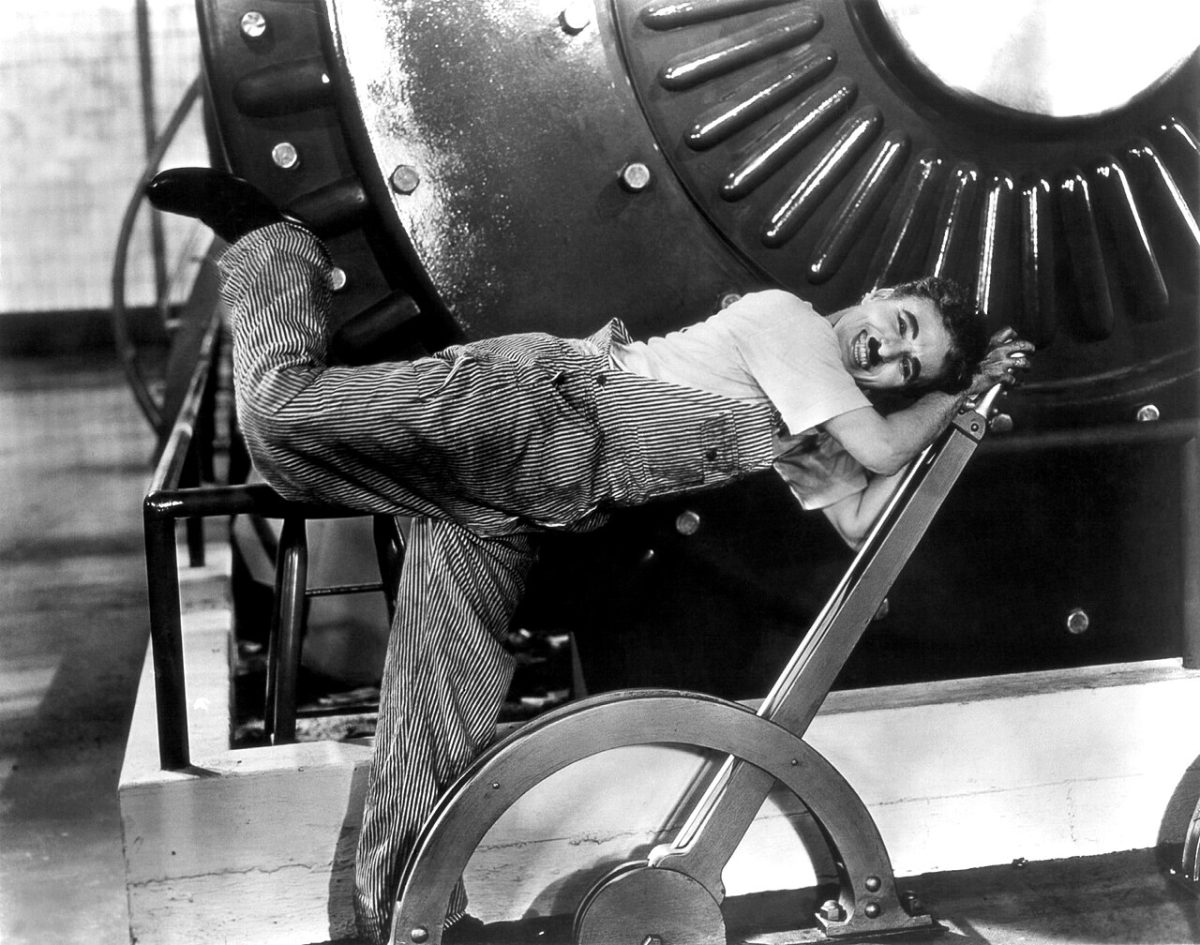
A great advantage of much older comedy films, for instance, is that sparing use of dialogue and minimum narration encouraged filmmakers to use visual irony as a means of conveying humour. Although most young people primarily associate his films with slapstick comicality and expressionist acting, Chaplin actually made ingenuous use of blocking and comic timing. As a filmmaker, he was much admired (if not worshipped) by the “serious” likes of Tarkovsky, who found his work to be unexpectedly poignant and visually inventive. In Modern Times, for example, there is a scene where the Tramp, newly released from prison, attempts to return a red flag that has just fallen from the trunk of a passing van. He rushes headfirst toward the camera (posed upon the receding vehicle), waving it frantically, when a crowd of Marxist protestors – thinking he is leading them – follow behind and create a ruckus that lands the Tramp in trouble again.
There is also the famous scene at the film’s end where, working as a waiter, the Tramp attempts to serve a certain curmudgeonly gentleman a platter of roast chicken. Instead, he is flung into a whirlpool of dancers in the centre of the hall, as the viand gets caught on the edge of a chandelier and the cantankerous customer grows more wrathful by the minute, before the Tramp finally shows up with what he finds is an empty platter. Such scenes are comparable only to a handful of works by Buster Keaton and Jacques Tati, their comedic nature being conveyed in purely two ways — visual stimuli, and the juxtaposition of the viewer’s knowledge against the characters’ scope of vision. This proves that there is much to be learnt from how silent films orchestrated movement and stillness to portray ironies that words cannot communicate as sparingly as images.
In a similar vein, perhaps in order to work around insufficient technical sophistication of dialogue and narration, older films also make clever use of associative editing — creating meaning through an isolated succession of shots whose sum creates a specific emotional effect in the viewer, a technique introduced to the cinematic world by the ground-breaking theories of Lev Kuleshov. While in most modern films, editing becomes a vessel for creating a succession of movements that further the plot, in the early days of cinema, it was used with much more scrutiny due to lack of means to convey complex and abstract ideas. Eisenstein’s Battleship Potyomkin, though primarily regarded today as mere Soviet propaganda and a rather dry exercise in editing technique, is actually much more engaging than the modern viewer would expect. There is a scene in the film where sailors aboard the battleship, brooding over mutiny, complain to the milquetoast Doctor Smirnov that their stock of meat is being gnawed by worms. A small inspection follows, after which it is concluded that they are merely maggots and can be washed away by some salt water. Later in the film, the rather grotesque shot of meat being devoured by vermin gains added significance and a note of delightful irony when the sailors manage to throw their irascible captain off board. They claim that he has “gone to feed the fishes” as we see a fleeting shot of those very same worms, making the film abound in examples of how powerful ideas can be packed into two or three isolated images.
Consider also, for instance, an earlier scene when a squadron prepares to open fire on a group of mutineers and Eisenstein creates a short montage of two alternating shots recurring repeatedly one after the other: An officer is shown slyly tapping the edge of his sword, and a priest swaying a glowing crucifix, reflecting how for the Bolsheviks, the Imperial Army and the Church were but one and the same scourge. In a different scene, the dead captain’s spectacles are shown dangling by a thread, compelling the attentive viewer to recall an earlier shot of the mutineers being hung on the masts. Eisenstein shows – with just two images – a reversal of power dynamics and an irony that would be too cumbersome for words to formulate.
One would also be surprised to find out how some earlier, more rudimentary adaptations are actually far more interesting than their technicolour remakes, though technologically inferior. Take the much-laureled and internationally lauded 1956 film The Forty-First about the Russian Civil War, which stages the tragic romance between Red Army sniper Maria and the White Guard officer Vadim. Watching this film, one is mesmerized by the wide panes of the Kazakh steppe, the bright blues of the sea that recall Vadim’s eyes, and the blazing fires that echo Maria’s passion. It was, however, the 1927 version that struck me most through the sparing yet biting nature of its visual storytelling. Instead of a banalized “But I’m a Red and you’re a White!”, filmmaker Protazanov reflects the transgressive nature of their relationship through the simple imagery of things falling apart. As Maria attempts to nurse the ailing and delirious Vadim — overlooking his position as her political enemy — the stew she boils begins to tremble on the stove until it foams up beyond the rim.
This visual ‘sentence’ is repeated once again as Vadim later gathers a pailful of lobsters and proudly shows them to Maria. The two lose themselves in a delirious lock of kisses when the camera turns our attention to the crustaceans scattering out of their bucket, reflecting how Maria has forgotten the Bolshevik cause. It is the conclusion, however, that distinguishes the two adaptations most strikingly: in the 1956 version, when Maria finds out that Vadim has betrayed her and forsaken their love for his White Army comrades, she shoots him and tearfully watches the sea sway his unmoving body. In the 1927 version, however, after Maria shoots her lover and begins ruefully crying, a Red soldier appears and asks her “Who is that man?”. She looks back at the body, yet the camera shows us not his face, but a vignette-like shot of his White Army medal; and then her tear-soaked face, and finally, the medal once again. It struck me that the rather cynical and solemn ending of the original, in comparison to the perhaps more human and sympathetic (albeit melodramatic) conclusion of the remake, reflected the story’s ugly truth more powerfully: the brutal nature of the Russian Civil War was such that it spared no mercy for feelings of love and human compassion.
On a much less serious note, another interesting aspect of older films is that censorship and prudish sensibilities made room for more creative expressions of intimacy and love. In a world where sex has become almost banalized in the film industry, the last place one would expect to find a creatively edifying portrayal of it would be in a black and white silent romcom from Soviet Russia. Abram Rom’s 1927 film Bed and Sofa tells the story of a tempestuous love-triangle between two flatmates and a housewife, as they are compelled to live awkwardly close together owing to the housing shortage following the Bolshevik takeover.
In an ingenuously crafted scene that portrays the the growing adulterous passion between Lyuda and Ivan, Rom creates a delightful metaphor with playing cards: Ivan offers to tell Lyuda her fortune and slyly places the king of diamonds on top of the queen of spades, as the next scene switches immediately to a shot of a disheveled bed. Just as Hitchcock uses a shot of a train rushing through a tunnel in North by Northwest as a sexual innuendo, Rom shows how the various constraints of censorship actually encouraged the viewer to avoid passive observation and exercise their associative intellectual capacities.
Similarly, although one might consider the French to have the least prudish of sensibilities, Goddard’s Vivre sa Vie – a film about the struggles of a young Parisian sex worker – features nothing even half as explicit as we would expect. In an excellently crafted montage where Nana meets one client after another, the shots are framed in such a way that we see only her indifferent gaze peering from over the bare shoulder of a completely unknown man, allowing Goddard to show us the loveless nature and unequal dynamics of the act, and thereby conveying her predicament more poignantly. While films today can be lauded for their portrayal of sexual frankness, it is in those of the past that we can learn not to show, but to tell.
It is more essential than ever to revisit these treasures of old cinema – whether they are well-known classics or relatively obscure – in order to learn how to listen to the unique language of cinema and value its humble origins. As films become increasingly inseparable from lucrative industries, and actors become difficult to distinguish from their status as celebrities and public personalities, we must educate ourselves and exercise our visual judgement through earlier examples of cinema. Through this, film can be able to recover its status as a respected art form, and eschew its growing synonymity with entertainment.