
[This review contains spoilers about GREYJOY. You have been warned!]
White. Anyone at all familiar with a hospital waiting room knows all too well the cold and uninviting atmosphere that the colour creates: sterile, barren, isolating, artificial.
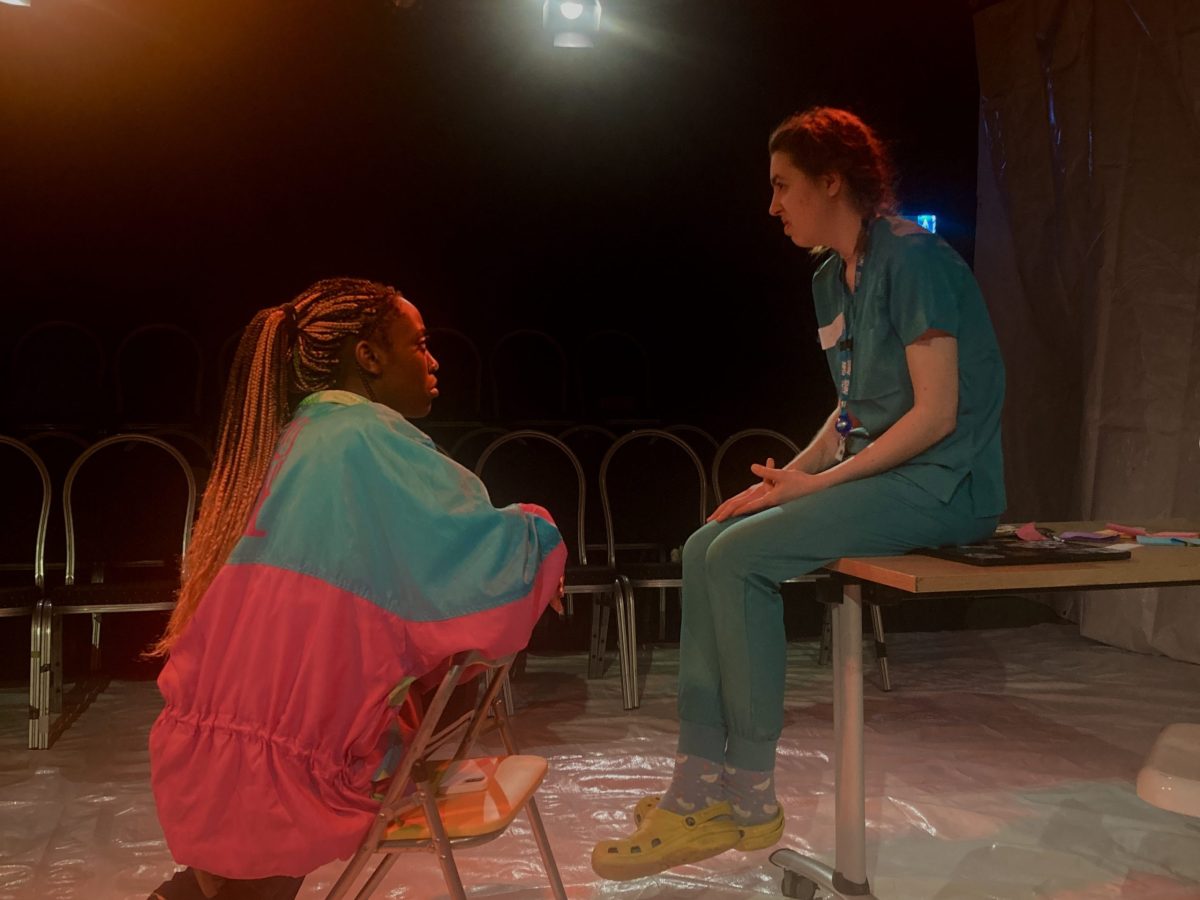
This is the atmosphere that Blackstar Productions manages to evoke as you step into the Pilch Studio. This white creates an artificiality that draws attention to itself: one long white sheet of tarpaulin draped across the middle of the black-box theatre, awkward, displaced, and too visible as the centrepiece of the set.
GREYJOY– a play written and directed by Rebecca Harper – is a theatrical experiment, as Harper herself comes out to charmingly disclaim before the play begins. With cold reads from unprepared actors (each performing a one-night stint) as doctors-in-training, this bold move works well to fuse the comedic and awkward with moving presentations of grief, isolation, and trauma.
The story follows Mina (Bobby Tregear) and Cait (Zee Obeng) – the former a 25-year-old maternity ward intern supervising medical examinations, and the latter a 24-year-old out-of-work-actor volunteering as a mock patient between work at a coffee shop – as they navigate their individual struggles, professional dissatisfaction, mourning, family disappointment, and anxiety, by embracing openness and vulnerability.
It is Cait, sitting alone in the middle of the set, to whom we are introduced first. Her closed-off demeanour is quickly contrasted by the frantic, emotionally overbearing and inquisitive Mina, who between trials attempts to initiate conversation as Cait distractedly checks her phone.
Further emphasising the hyper-artificiality of Mina and Cait’s stilted, awkward dialogue is the decision to have the two review the performances of trainee doctors. The decision to stage on-stage reviews of the doctors’ – or rather, the unrehearsed actors’ – performances draws attention to rehearsed scripting that occurs in real medical scenarios. Here, such cold, awkward, even comedic interactions are placed in juxtaposition with Mina’s emotional character. She is even explicitly condemned by her boss Martin (terrifyingly enacted by Macey Pattenden) for expressing emotion on the job.
Our protagonists eventually open up. First, as a doctor-in-training (Xander Lewis, importantly not a one-night star) goes off-script to discuss his anxieties about his mother’s cancer, Cait is prompted to reveal her anxieties surrounding her sister’s suicidal tendencies, all while Mina watches. Mina herself privately cries following the interaction, going on to silently rearrange the set as a stifled radio plays overhead and the audience becomes all too aware of her isolation, praying for the return of dialogue, of company.
After flipping the set, Mina and Cait appear to switch roles, with Mina now standoffish and Cait all too eager to share. However, the interchangeability of human roles becomes unsustainable, as Mina breaks down in a tender moment that draws attention to the mistreatment of healthcare professionals, in addition to her personal grieving for the loss of her father. The sharing of their griefs culminate in a sense of comfort, of not being alone – though both characters must work to realise the value of their openness. Tregear and Obeng excellently express their overwhelm, perhaps best exemplified when Obeng attempts to enact both Cait’s role as a manic mock patient and Mina’s duty of reviewing the trainee doctor’s performance. It is a scenario so challenging that it calls for the usually composed Cait (or perhaps even the improvising Obeng) to consult her script as she becomes overwhelmed by her multiple performances. It is symbolic of the core tenet of the play: that it is impossible to maintain a pretence of emotional stability.
Perhaps the most harrowing moments are ones in which silence dominates – when Mina (unconvincingly) cries at her desk, or the silence that follows her piercing scream, a “war-cry” encouraged by Cait, but which has seemingly been building up inside her from the start.
A bell rings – as it often does to signify the end of a scene, a trial, or a performance. And, like Pavlov’s dogs, the audience have come to expect a laugh at the peel of this bell. This we receive when Mina and Cait themselves burst into laughter, turning the “war-cry” into a feat of comic performance .
The comedic elements work well to break up tension – notably in the cold reads that range from anxiously delivered, to dishevelled (with Peter Sutton delivering a comedy performance so good that he even made Obeng break) and even calmly cold. This comedic relief too can be found through the cold-read form, as Madi Bouchta, first a calm, collected doctor, must stifle a cough, making her already manic exam presentation at an even faster pace than planned, and making for an even more enjoyable watch.
As the end approaches,Cait and Mina set up a date, perhaps both drawn to the fourth stage of grief Cait’s friend created – ‘lesbian sex’. Yet this ending feels abrupt, incoherent with the rest of the story, the trite, artificial intimacy of their set-up emphasised by a gaudy pink spotlight that ends the scene. Further, this mere impression of intimacy is reiterated by a final phone call between Cait and her sister, the cause of her anxiety throughout the play. Her sister – a disembodied voice on the other end of the phone – alludes to their communication through memes, another way to draw attention to the disconnected moments of intimacy we allow ourselves to indulge in today, not allowing ourselves to be open and vulnerable.
Yet, this artifice works in service of the play’s general tone, at once self-mocking and self-aware. Self-awareness seems the undercurrent of the play itself, complimented by the posters dotted along the pillars that frame the stage from the audience. From real medical leaflets to and mock posters that ask: “Are you sure you’re meant to be here?”, you are forced, from the moment you enter, to consider the role you play. One can only imagine what the cold-read actors felt like as they darted from audience member to actor.
Dotted too amongst these posters are post-it notes hand-written by cast and crew (some in character, some not) in addition to a poster pointing out, perhaps ironically, that Blackstar Hospital takes care of their staff. Here, we are made aware that, above all else, the play is an experiment that demonstrates how comedy works as a tool to overcome grief. How vulnerability, and connection, are, though here performed, inherently human. In a play that at first seems to highlight the mistreatment of medical professionals, whose humanity is forgotten by rehearsed, robotic, conduct, there is a much deeper meaning connecting audience and actors as performers. Somewhere between artifice and reality, GREYJOY grapples with themes of mental illness, death, and grief, making laughter – unpredictable and unscripted – the best medicine.
[GREYJOY, an original play staged by Blackstar Productions, is running at the Michael Pitch Studio, 28th-31st January]