
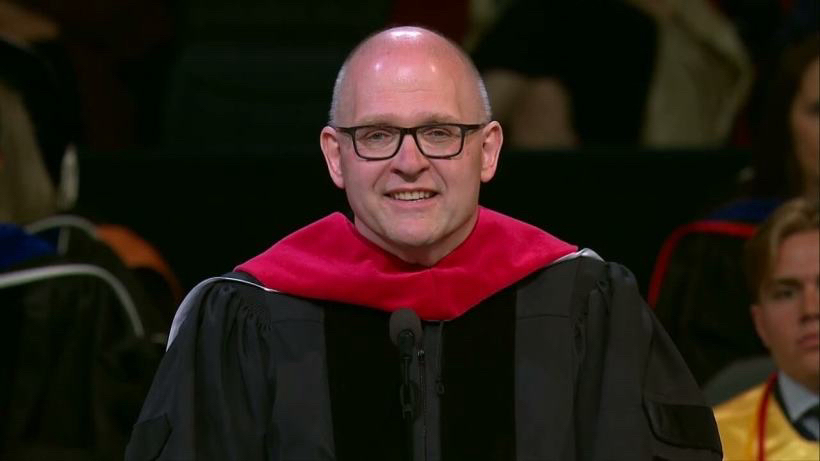
Reverend Dr. Andrew Teal has been the chaplain at Pembroke College for 22 years, and he is not leaving anytime soon: “This is where I belong.” What is central to Rev. Teal’s work as an Anglican minister is his interfaith engagement, which involves opening up his chapel to individuals from various faith backgrounds. Just last term, Pembroke Chapel hosted their first Jewish evening prayer, around 700 years after the exile of the Jewish community from the city. Rev. Teal points to the old stone wall just behind the chapel, which would have been where the Jewish community predominately lived before their exile. He is clear: “The chapel is for everybody. It’s all right saying it, but you have to show it.”
Rev. Teal’s chapel is a place of inclusion for all faiths and all people. Quoting Jeffrey R. Holland, the late Latter-day Saint Apostle and close friend of Rev. Teal, “you don’t leave your faith in the cloakroom.” For Rev. Teal, it is inappropriate to ask people to leave behind anything that is core to them when entering his chapel, whether that be their religious identity, gender, or sexuality: “This is people’s home. It’s an environment for work and encounter where everything around each of us has to be just loved.” This is why Pembroke Chapel has hosted a variety of religious practices, from Hindu puja to the Muslim call to prayer. Meaningful interfaith conversation is rooted in this spirit of inclusivity and friendship amongst different faith traditions.
Rev. Teal’s close involvement with the Church of Jesus Christ of Latter-day Saints is especially noteworthy. He is well-versed in the Book of Mormon, one of the key scriptural texts for Latter-day Saints, and even holds the position of Associate Faculty member at Brigham Young University, the flagship university of the Church of Jesus Christ of Latter-day Saints. Rev. Teal speaks fondly of his friendship with the late Latter-day Saint Apostle, Jeffrey R. Holland, who delivered a series of talks on interfaith work in Oxford, at Rev. Teal’s invitation. This included Elder Holland’s participation in an interfaith panel with members from various Christian traditions, including the former Archbishop of Canterbury, titled, ‘Inspiring Service’. This 2018 panel went on to inspire the publication of a book of the same title, co-authored by Rev. Teal, which focuses on the building of relationships between various denominations to help support the common good through united humanitarian efforts.
For Rev. Teal, the importance of interfaith engagement lies in the need to respect the ‘otherness’ of human beings. The goal is not to absolve the key differences between religions, melting down all faiths to a singular, unified entity, but rather to embrace, love, and maintain the “rainbow of differences.” This is Rev. Teal’s vision for his chaplaincy: the “celebrating of the diversity and the dignity of each person and of communities.” It is so common for us to carelessly put people into categories, imagining that we simply know what they are. But for Rev. Teal, “the life of dialogue is where we find who we are, and it’s therefore indispensable…that means encountering the otherness of somebody.” It is only through interfaith friendship and true, meaningful engagement that the ‘otherness’ of human beings can be fully embraced.
Rev. Teal quotes St Francis of Assisi’s Prayer for Peace: we should “seek rather… to understand, than to be understood.” The significance of understanding is core to Rev. Teal’s chaplaincy, as he states that faith stands for the “abundance in what human beings are”. Interfaith engagement should be driven by the desire to appreciate and understand the differences that constitute this human “abundance”.
It is through coming together in a spirit of friendship, eating together and praying together, that the diversity of different faith traditions can be fully respected and understood. Last Pentecost, Pembroke chapel hosted the first Roman Catholic Solemn Mass since 1527. The Papal Nuncio attended and flew the Vatican flag, conveying Pope Leo’s personal message of gratitude for this open sign of welcome towards the Catholic community. Such an expression of religious inclusivity can be a source of fear for some; Rev. Teal notes that some are apprehensive of interfaith engagement as they worry it will water down their own beliefs. In his case, it has been the opposite. Rev. Teal reflects on his friendship with the Imam at the Islamic Study Centre, which he feels has made him a better Christian, and the Imam a better Muslim.
This building of an interfaith community is so important for Rev. Teal because of its potential to become a force for social good. Members of various faith traditions can unite their charitable efforts and promote real, lasting impact. The work of the interfaith community can show that religion is “a motivation for us to engage and get our hands dirty, roll our sleeves up”. Religion should not be reduced to a mere escape from the world: “what’s the point of being good as gold and fit for heaven, but of no earthly use?”
This is what motivates Rev. Teal’s involvement with the Freedom of Religion or Belief Forum (FoRB) and their LGBTQ+ alliance. FoRB has advocated against the treatment of Uyghur Muslims facing severe persecution in China, and has worked to defend the freedoms of Humanists in Nigeria sentenced to 26 years in prison for their beliefs, being accused of violating blasphemy laws. Rev. Teal emphasises the importance of defending the freedoms of others who hold beliefs entirely different to one’s one – advocating for the freedom of the Humanist in Nigeria does not make Rev. Teal a blasphemer. Rather, “freedom is something that, if I try to maintain it for somebody who thinks the exact opposite to me, then I’m really standing for freedom.” This attitude captures what is central to Rev. Teal’s work – truly embracing the ‘otherness’ of human beings requires defending the fundamental human right to hold a variety of beliefs, both religious and non-religious.