
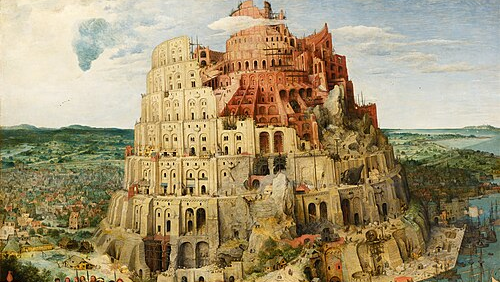
According to the legend of Babel, the existence of different languages on Earth began as a punishment. Humanity, daring to build its tower skyward, was scattered by God and condemned to mutual unintelligibility. Later centuries imagined a return to the lost original language. The 17th-century philosopher Francis Bacon, for instance, thought Chinese characters might offer the potential for a new universal language. Today, some argue that “globish” (global English) is becoming one. Yet, in our times, we are more likely to question the Babel myth’s assumptions about uni- and multilingualism, rethinking which is the gift and which the curse.
If language structures the world around us, breaking it down into blocks we can name, then could different languages, with their diverse vocabulary and grammar, yield different worlds? This is the line of thought behind the theory of linguistic relativity, often referred to as the Sapir-Whorf hypothesis. The idea that language can influence perception continues to animate linguistics, psychology and even the imagination.
One of my favourite sci-fi films, Denis Villeneuve’s Arrival (2016; based on the 1998 short story “Story of Your Life” by Ted Chiang) dramatizes Sapir-Whorf through an encounter with the otherworldly. When extraterrestrials arrive on Earth, linguist Louise Banks (played by Amy Adams) must decipher their logogram language of inky, circular symbols to determine whether they wish the human race harm or good. Interpretation becomes a livewire, with the first sign of a threatening (mis)translation set to trigger the offensives of the US military. Yet, as Louise learns the alien language, her own thought patterns – and her sense of time – start to shift in curious ways.
Arrival (2016), a ‘letter’ from the alien language
The notion that language shapes how we consider time is not limited to science fiction. English tends to imagine time as moving forward, with the past behind us and the future ahead. Yet, speakers of Aymara, an indigenous language of the Andes, reverse this orientation. The word “nayra” (“front”/ “eye”) refers to the past, while “qhipa” (“back”/ “behind”) is connected to the future. In gesture studies, Aymara speakers point forward when speaking of yesterday. At first glance, this may puzzle English speakers. But how does your perception change when you consider the past as something known, seen, as though in front of you? And the future as unknown, unseen, and therefore behind?
Language is inextricably linked to culture, as it affects how we frame what we see. “It doesn’t mean people see differently,” explains Oxford alum and (my favourite) author Natasha Pulley, “Just that they think differently about what they’re seeing.” In Pulley’s novel The Bedlam Stacks (2017), the English protagonist Merrick initially struggles to grasp why the members of the Peruvian community in which he finds himself seem to see the past as ahead and the future as behind. But it suddenly clicks when he conceives of time as a river. “Your ancestors set off before you did, so they’re far ahead,” Merrick realises. “Your descendants will sail it after.”
Such reflections extend beyond time to colour. Many languages, including that of the Himba people of Namibia, have a term to denote both green and blue, sometimes referred to as a “grue” category. In related linguistic experiments, English speakers had more difficulty identifying the “grue” colour from a general colour chart, while Himba speakers identified it with ease, likely due to the centrality of this colour in their language.
Pulley turns to this chromatic idea in The Hymn to Dionysus (2025). While English speakers might imagine the sky and sea as the same colour – blue – the Ancient Greek lexicon works differently. The term “khalkos” (meaning bronze or copper) is famously used to describe the sky. Pulley’s narrator, the soldier Phaidros, admits he could not understand for a long time what foreigners meant by blue. Readers, in turn, must puzzle over a “khalkos” sky, until Pulley urges us to think about the way light flashes off copper or bronze, and how these metals look once they oxidise.
So, if language shapes thought, can bilingualism offer up new cognitive worlds? Some research suggests it may even influence moral decision-making. The trolley problem imagines a runaway tram or train heading towards five people tied to the tracks. The bystander can intervene. In one version, they can push a man off a footbridge to stop the train. In another, they can divert the train using a lever so it will be directed towards just one person on a different track. Faced with the choice of intervening or witnessing, sacrificing one life or five, what do you do? Studies found that bilingual individuals were more likely to opt for a utilitarian, pragmatic solution (sacrifice one life to save five) in a foreign language, whereas participants responded more emotionally in their native language. One possible explanation is that first languages are often tied to family and the home, while second languages tend to be spoken in institutional settings.
Discovering and deciphering puzzling words and concepts in new languages – like the past in front and “khalkos” – are among Pulley’s favourite things about learning them. I have to agree. The “Venn diagram[s] of meaning, with an overlap that the speakers of both languages understand… but outlying shades on either side that don’t line up” are fascinating. Far from the curse of Babel, linguistic diversity might instead reveal how many different worlds can exist within the mind.