
Ah, ‘Beckettian’. It’s one of those delightful words that means something very specific, yet also means nothing at all. The definition is obvious: reminiscent or characteristic of the works of Samuel Beckett. Yet pinning down what this actually means – what defines Beckett’s work, what drives it – and applying it to the works of other playwrights, is another thing altogether, and provides a serious headache even for a Beckett fanatic like me. Thus, when I saw the word ‘Beckettian’ on Oxford Playhouse’s website used to describe Deaths and Entrances, the new play (written and directed) by Nathan A. Harris, I knew I had to see it. Fortunately, after a thoroughly enjoyable hour at the BT, I can say that Harris’ play largely lives up to this elusive adjective, and provides a night of great slapstick fun, laced with whispers of despair and warnings against the rise of authoritarianism.
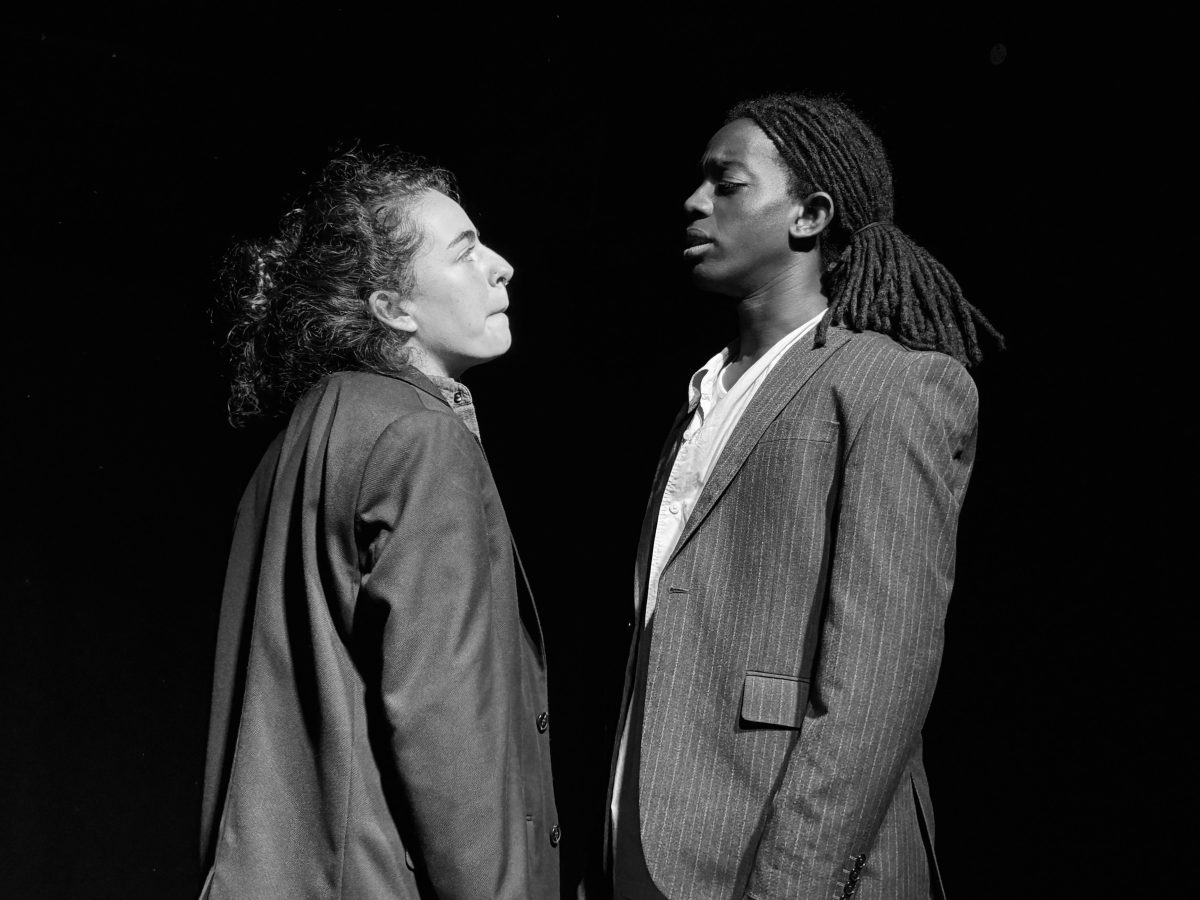
As the lights go up, we are introduced to the cantankerous Alf (played by Libby Shirnia) and Rube (Harrell Maguru), a pair of vagrants one cannot help but compare with Vladimir and Estragon of Waiting for Godot. Like Beckett’s symbiotic pair, they are inexplicably bound to each other: Alf and Rube finish each other’s sentences, entertain one another’s nonsensical musings, and get repeatedly lost in the inertia of the other’s company. However, while they cycle through familiar themes – the virtues and vices of money, what it might be like to live under water – Harris takes care to ensure that a sense of something sinister lurks under all the dialogue.
At the outset of the play, Rube insists to Alf that things in the world of the play are ‘getting worse’. We hear that ‘they’ have ‘new uniforms’ that are ‘all black’. The details are vague, but the impression is one insurmountably authoritarian, tinged with resonances of Hitler’s SS. One familiar only with Beckett’s early works might consider warnings against fascism an incongruous presence in a Beckettian play, but much of the Irishman’s later work – What Where and Catastrophe come to mind – abounds with warnings against the power dynamics that enable authoritarianism to take hold.
Initially, the authoritarian backdrop of Harris’ play is just that: a backdrop. Alf and Rube fade in and out of talking about the political situation, and routinely find themselves distracted by lighter conversations. Yet, as the play progresses, it is scary how quickly this moves to the foreground. Like The Protagonist of Beckett’s Catastrophe, a submissive actor moulded by a sinister and tyrannical director, Alf and Rube seem to favour inaction over action, regarding the play’s political situation with mild discomfort rather than attempting to do anything. Soon after these conversations, Alf has been arrested for taking part in a (distinctly chaotic) robbery. Soon after that, he is dead, his life taken from him by the opaque workings of a corrupt justice system. It is frightening, and supremely effective, how quickly a fascist backdrop becomes a fascist foreground in Harris’ play. The characters’ naive and nonsensical chatterings at the opening of the play become an act of political failure, a refusal to act against authoritarianism before it is too late, and the effect is nothing short of terrifying. Alf and Rube’s bond – deftly established by Shirnia and Maguru – is suddenly severed, and soon I find myself watching Rube’s eulogy at Alf’s funeral, unable to take any action against what happens onstage, turned into yet another helpless audience member merely observing the rise of authoritarianism. The sensation is harrowing, and supremely effective.
There were, however, minor issues. The intricacies of Harris’ script did a good job of sustaining the audience’s attention through the hour, but I could not help but feel like some more dynamic blocking would have helped capture the vibrancy of the script a bit more. The brief slapstick interlude wherein Alf attacks Rube reminded me of how much potential there is for fun and energetic movement in a Beckettian play, and I was slightly disappointed not to see this energy expanded on further, with the characters sitting stationary in the centre of the stage for most of the play. The poetic interludes of the play set by a river, moreover, were a welcome change of pace, narrated beautifully by Shirnia and Maguru, but I did often think the sound design hindered these scenes, drowning out the characters’ softer dialogue with the (strangely loud) sounds of water purling. On the other hand, Yolanda Zhou’s lighting design did a great job of distinguishing between the play’s different settings, and the lighting state used for the foregoing poetic interludes was a delight, bathing the two vagrants in soft, blue light.
On the whole, Deaths and Entrances is a great hour of entertainment, paradoxically discomfiting and funny, light and heavy. Harris builds on Beckett’s tragicomic rhythms to fashion a deftly acted cautionary tale against the subtle rise of authoritarianism, and the insouciant observers who enable this rise by doing nothing. The result is a play that, above all, makes you think, and is certainly worth the price of admission, despite minor issues.
[Deaths and Entrances, an original play written by Nathan A. Harris and staged by Dirty Dog Productions, is running at the Burton Taylor Studio, 3rd-7th March, 2026]