
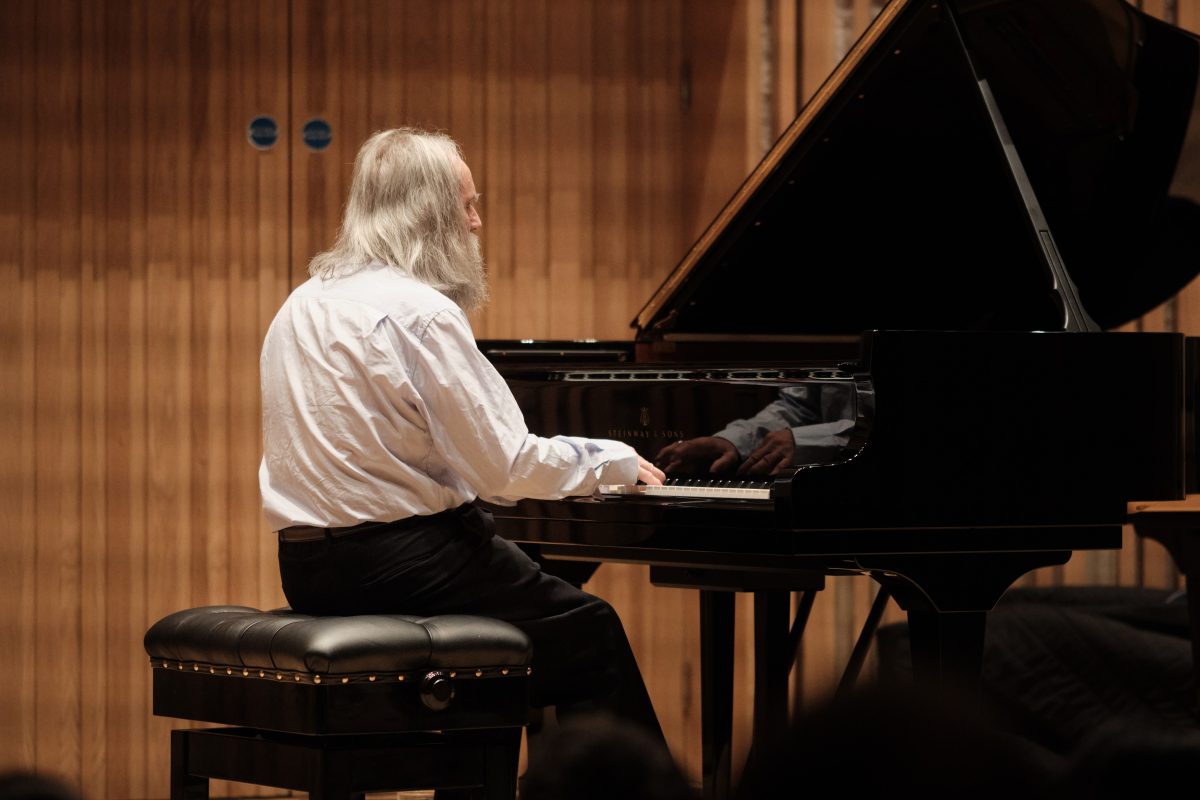
Ukrainian pianist Lubomyr Melnyk, aside from holding two world records for being the fastest pianist in the word, has amassed much critical attention, primarily for developing a ‘new language for the piano’ in the 1970s, dubbed ‘Continuous Music’ (examples of which can be found on Lubomyr Melnyk’s website). An overlooked form of music in need of renewed critical attention, “Continuous Music is important now, because its background message was always important but is being increasingly less well-heard and is increasingly urgent,” says Nathan Adlam, co-secretary of the Balliol College Musical Society, organiser of the event, and currently Melnyk’s sole student and devotee.
Continuous Music has proved, even for Melnyk, almost beyond definition. He prefaces the concert by telling us it touches on the ‘divine.’ If not ‘divine’ then at least meditative, and often likened to a hallucinogen-induced experience live, Continuous Music is also well suited in its partnership with Creative Empirical, who were using Melnyk’s tour shows as part of their study Altered States of Consciousness. In addition to academic attention, filmmaker Rupert Clague currently has a documentary on Melnyk in the works, a testament to both his talent, his philosophy, and the impact of his music.
His own website describes that the piano responds to Melnyk himself. People often report that during live performances, ‘they heard trumpets, horns, entire string orchestras emanating from the piano.’ Having gone in something of a sceptic (indeed going as far as to consider the philosophy somewhat pretentious) I was pleasantly surprised to really experience that indescribably quality of the music. Defined in very simple terms, Continuous Music is the creation of an unbroken line of sound from the piano by generating a flow of rapid notes with the sustain pedal held throughout. And yet, it really is a remarkable, almost mystical, thing to experience live, that connects the audience in their individual experiences of reflection and captivation.
Elevating the emotional experience above just the mythical and ‘divine’was the fact that Melnyk final concert in this Oxford run took place on February 24th, 2026, four years after Russia’s first invasion of Ukraine. Dasha Nepochatova, president of Oxford University Ukrainian Society, movingly recounted her memory of the outbreak of war before the concert began, and held a minute’s silence in honour of those lost and suffering.
This silence amplified an already anticipatory tone when Melnyk himself finally emerged. Opening with a broadly improvised piece that Melnyk assures is ‘completely new and unique,’ the audience are told that this time spent in the present is unlike anything that has come before, and something that will forever live with us. In Melnyk’s philosophy, the piano is never the same, for each time it is played, an impression is made upon it. Much like the audience, its aging, its finite experience, its being touched makes it a completely different instrument moment by moment.
Following this introductory piece came a performance of The Sacred Thousand, a composition inspired by the ongoing Russia-Ukraine war, and one that Melnyk decides that he will not play in its entirety to represent the continuous nature of the war, one emphasised by the lingering notes that Continuous Music is comprised of. The result was something both harmonious and haunting as he held his audience in a captivated, contemplative silence. Though this 20-minute feat originated in commemoration of a particular group of soldiers, he had previously expressed that the piece is more broadly applicable to onslaught throughout time, the droning notes he plays with his right hand echoing not just the relentlessness of war, but also heroic endurance and resistance.
‘Don’t forget us,’ Melnyk quietly utters after suspending the room in an emotional trance, inviting reflection, remembrance, and continued support. After charmingly checking his watch for time, Melnyk dives into a passionate explanation of his final piece The End of the World, which quickly devolves into an environmentalist rant. Inspired, he divulges, by the opening image of La Traviata, in this piece he invites us to envision with him the death of a globe-headed Mother Earth. The longest of the three pieces, the image of catastrophe he invokes is one that is suitably conveyed by repetition, false climaxes, and a final, fading note, at once mournful and hopeful (much like his lengthy speeches about electricity and nuclear power).
Melnyk’s art is invested not just in the sonic experience, but the bodily experience at large. Thus, the decision (inspired by an accidental power-cut on the performance of the 23rd) to play his final piece in almost complete darkness (one he rejoices is saving electricity too) really heightens the space for meditation, for being lost in and fully embodying the experience of his music. It is not just a moment for personal contemplation, but a music that arrests the audience’s attention and directs it fully toward the moment, leaving no room for the mind to wander.
Playing in darkness is not only a unique experience for the audience, encouraging our complete surrender to the music, but also another way for Melnyk to flaunt (albeit humbly) his almost other-worldly talent. His technique consists of motions so fluid and gentle that one may forget he is playing with any vigour at all, broken up only by the knocking of his ring against the keys. In such an intimate venue as The New Space, eager silence makes no amplification of the instrument necessary.
“There is something impossible about this music,” says Nathan Adlam. This indescribably ‘impossible’ quality is something the audience collectively recognised, sharing stunned silences and flocking to Melnyk with questions after the show. With a refreshing passion for the topic, Nathan was kind enough to answer a few questions about Melnyk’s philosophy and Continuous Music:
Do you think that Continuous Music and/or Lubomyr’s art is given more beauty, or made more important, by the very fact that it is indescribable?
‘[F]undamentally: yes, for me, a large part of the beauty comes from the indescribability, but specifically from the perception of a vague, tremendous shadow of underlying structure and mastery sitting within the undescribed cloud: it is not chaos, and not a wall of sound – it has a beauty from the way there exists a human to whom it does make sense and therefore this wonder, if we may it call it that, belongs to us; is of humanity. I know there’s structure, because I know the man who wrote it and performs it – I know there is a mind and an emotional landscape behind it. I also know he’s very human, with many flaws that I can recognise and things I can do which he cannot. The music is vulnerable in that he wears his heart on his sleeve and gives himself entirely, on stage, and really the indescribability of his music is quite similar to the indescribability of emotion in general. It’s often a raw emotion in a primal, sometimes even terrifying way, as opposed to the very finely sculpted emotion of a classical composition.’
Why do you think Continuous Music is so important now?
‘I think it was always important [but] its importance has grown partly through a supply-and-demand kind of mechanism: [Melnyk] keeps getting better and better, year on year (yes, really, and he is 77) and it remains the case that he has no professional companions, no one who has embodied his insights to a high level, and without being unnecessarily grim he is also keenly aware that he has a finite lifetime and that that time is running out. We are also in a turning point for society [and] with the rise of AI-glorification […] Continuous Music brings you closer to yourself and to your fellow human, and has merits that AI cannot take away from you. It is of course not the point that a robot can in principle play faster than I can; while Continuous Music is hard to define, it is also almost tautological that a robot can never play Continuous Music. [Melnyk] once said that if he did not have to eat, he would not make recordings, because Continuous Music is entirely about the intimate, live human moment. The very first piece of his I learnt, Pockets of Light, is a piece I learnt note-perfect in a month but required years to really begin to understand and properly play.’
Since it is such a technical innovation, do you think Continuous Music can only be truly appreciated by musicians?
‘Absolutely not. Continuous Music can be, and very often has been, appreciated by absolutely anyone with the right level of emotional openness, and what I love is that everyone who does appreciate it appreciates it in quite different ways. It is a technical phenomenon, but let us also remember that for the performer it is very easy, and once the technique is at hand for a given piece it can be forgotten; the audience is welcome to forget the feat of it and simply enjoy the music too. I have found that those who try to use their (sometimes very considerable) musical toolkit to analyse this music have often fallen short of understanding it.
[…] It is not that there is nothing to analyse, but rather that there exists no scholarship around Continuous Music, and as yet no academic or ‘established’ frameworks with which to understand it. This is a work in progress, and work on this is partly why I am excited to be collaborating with Creative Empirical. The excellent classical pianist and pedagogue Emilie Capulet recommended that I take a DPhil in more or less this very subject: finding academic language so that future generations of trained musicians have an easy way in to understanding what’s going on. But, in the present day, this does not exist.’
Closing with a discussion of the Creative Empirical study, Nathan tells me: ‘I see very many angles, not all of which we will be able to cover, for clinical research on Melnyk and his audiences.’ As an experience that is completely immersive, meditative, and nearly religious (for both the performer and audience) it is hard to imagine a musician more worthy of such academic investment. Despite Nathan, and indeed Melnyk’s, fears of the finality of the form, both clearly express a hope for the progression of the technique as both an academic and creative, even a personally meditative, pursuit. Perhaps tautologically, then, for classical and modern musicians and audiences alike, it is exciting to apprehend the continuation of the form, and where it will take us next.
If you are interested in Melnyk, or Continuous Music, Nathan has set up a website (though still unfinished) in honour of Melnyk and his work.