
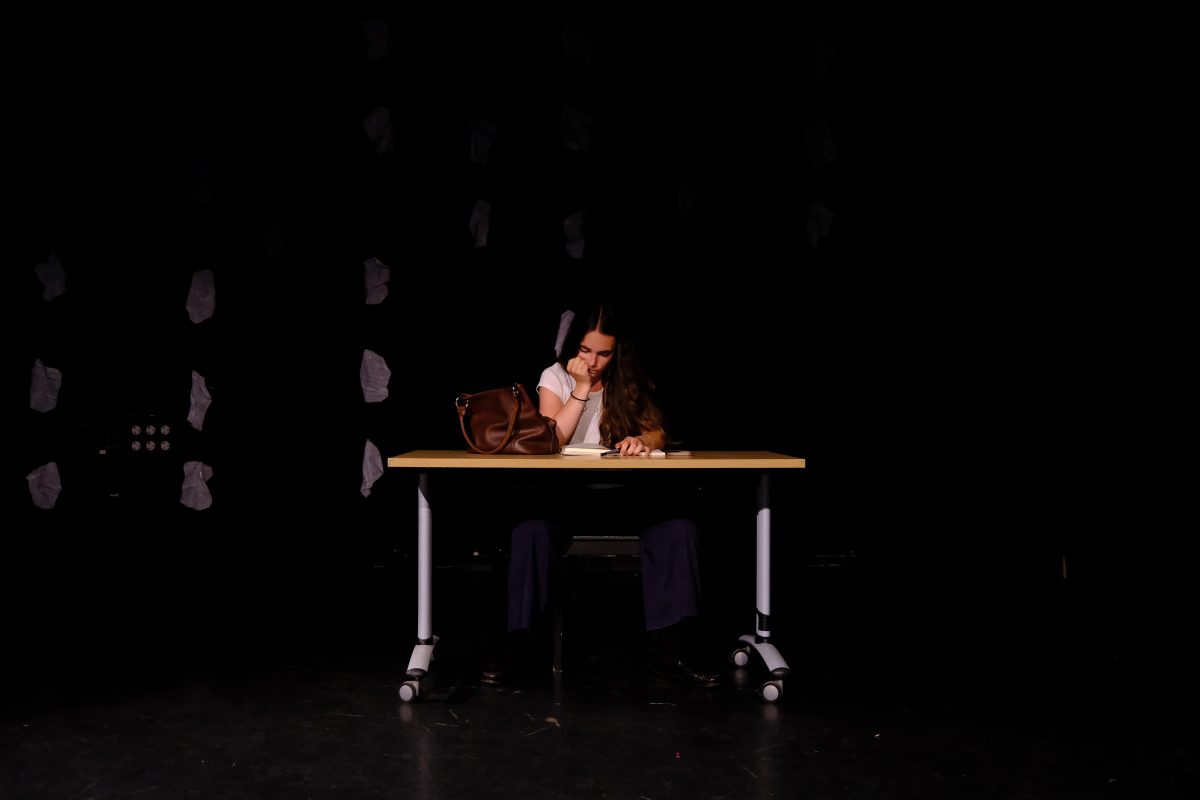
Crumpled pieces of paper hang from the walls of the Pilch. The lights are down. In darkness, two figures, dressed in all black, take their positions in the centre of the room. When the lights go up, these figures scream “Fuck you!” at each other. There is nothing hesitant or uncertain about this opening. The play begins as it means to go on.
Completely Bloody Incoherent, written and directed by Sasha Ranawake, broadly follows the relationship between successful playwright Dahlia (Hope Healy) and aspiring but struggling actor Luke (Ollie Gillam). Scenes between the couple are interspersed with scenes following Actors 1 and 2 (Seb Foster and Coco Scanlon) for roughly the first half of the play. The scenes between the first couple are chronological and believable; the scenes between Actors 1 and 2 are more dream-like and raw. At first these stories seem separate from one another, until Ranawake brings them together in a scene which essentially flips the way that we interpret the Actors.
Actors 1 and 2 are Dahlia’s performers – or puppets, depending on how ungenerous we want to be when considering her character flaws. The emotions they express are hers, their words taken from the notebook she writes in throughout the play. We are offered the art and the individual behind it. Here, the Actor is able to express an experience more openly, their words, even the tone of their voices, not diluted by politeness or emotional constipation. Neither Scanlon nor Foster waste this opportunity to go all out, and it’s a pleasure to watch.
Not only does the intertwining of plot threads shed light on the Actors and how we should interpret them, but they also unveil a new layer to Dahlia’s character in showing her perception of her relationship alongside the relationship itself. For me, the portrayal of this relationship was the most compelling part of the play. We trace Dahlia and Luke from meet-cute to happy relationship to growing resentment and finally to the explosive fight where truth comes out and everything ends. The dysfunctional relationship is hardly untrodden ground for student theatre, but the performances by Healy and Gillam are just wonderful to watch. Much of Completely Bloody Incoherent is concerned with believability versus truth, and how this comes out in art. The scenes between Healy and Gillam struck me as both believable and true. Their dynamic is incredibly charming. Although the play is structured in a sort of vignette style, this does not take you out of that sense of really rooting for two people who have such an enjoyable chemistry.
Healy plays Dahlia as somewhat sarcastic but introspective. One of the Actors calls her ‘intense’, which is probably the best description of her character. It becomes an opposites attract situation with Luke, who is, to start with, confident, relaxed and chatty. Ranawake goes much further with these characters than the rom-com-style beginning might suggest. Their interactions throughout are laced with the awkwardness which comes when you don’t say entirely what you mean. We watch as they dance around the truth and each other, not quite ready to fully open up. This awkwardness builds into arguments which manage to be both excruciatingly real and often incredibly funny. There is an argument at the dinner table about Brecht which got more than one laugh out of the room.
This humorous side to Completely Bloody Incoherent is also worth discussing. With so many questions raised about art, expression, and truth, alongside so many genuinely moving moments, I think it’s impressive that I’m still thinking about how funny some parts of the play were. Alongside the Brecht argument, there’s a scene in which Actor 1 imitates Leonardo DiCaprio in Inception – I won’t say more, go see it yourself – which was genuinely unbelievably funny. Although Gillam was perhaps the comedic standout for me, every single actor had great timing and tone of voice. Ranawake catches onto the absurdity that often comes in arguments with the people that we care about and plays this up on both sides, so that moments of the play are both upsetting in a very realistic way and also worthy of a laugh. It’s not a tough balancing act, either. Healy’s performance is perhaps the most emotionally charged, but the humour doesn’t play this down – rather it fleshes out her character more. The play as a whole and the individual actor serve to create a rounded and compelling character who manages to be believable and simultaneously carry so much truth about human relationships and the process of making art.
All of this plays out against a sparse backdrop of set, sound and costume. The pieces of paper hanging from the walls were the only permanent fixture opted for by set designers Elodie Yip and Falak Shah, the black box space of the Pilch otherwise left bare. The space that the characters inhabit, therefore, is unspecific, drawing attention to the universal nature of the emotional experiences of Ranawake’s cast. Leo Kilner and Lucian Ng’s sound design is similarly unobtrusive, most obviously present in the clicking sound – of a tape recorder, or an old set of slides? – which plays between each scene. Costume designer Thea Hughes also opts for the subtle. The Actors wear predominantly all-black outfits which emphasise their anonymity. The one scene in which they wear their own jumpers is quite lovely for giving us the slightest glimpse into their inner lives. Dahlia and Luke’s costumes are realistic and versatile. Luke’s mismatched socks as he begins to slip into self-pity and stagnancy was also a nice touch.
The lighting, however, designed by Ben Tilley, has a much stronger presence, particularly in the second half of the play. In a particularly revelatory moment of tension and truth, the lights spin, becoming another expression of distress. The final moments of the play, which I won’t spoil, are almost entirely reliant on the strength of Healy’s performance and the lighting design, neither of which disappoint. It’s a really compassionate and moving scene which I think perfectly sums up Ranawake’s consideration of art and character study of Dahlia.
Completely Bloody Incoherent is honest to a wince-inducing extent and somehow manages to achieve this without losing its sense of playfulness. It’s an impressive feat of student writing, never delving into poor pacing or self-indulgence. Each scene feels essential: for all the many questions that Ranawake’s script throws at the audience, the play remains tightly woven, all plot threads interconnecting, even if this is not immediately obvious, and coming to conclusions which feel real. This, alongside the strong performances from all cast members, makes the play a testament to the talent behind the team at Splinters Productions, and cements Ranawake as one of the standouts of the Oxford drama scene.
[Completely Bloody Incoherent, staged by Splinters Productions, is playing at the Michael Pilch Studio, 2nd-6th June, 2026]