


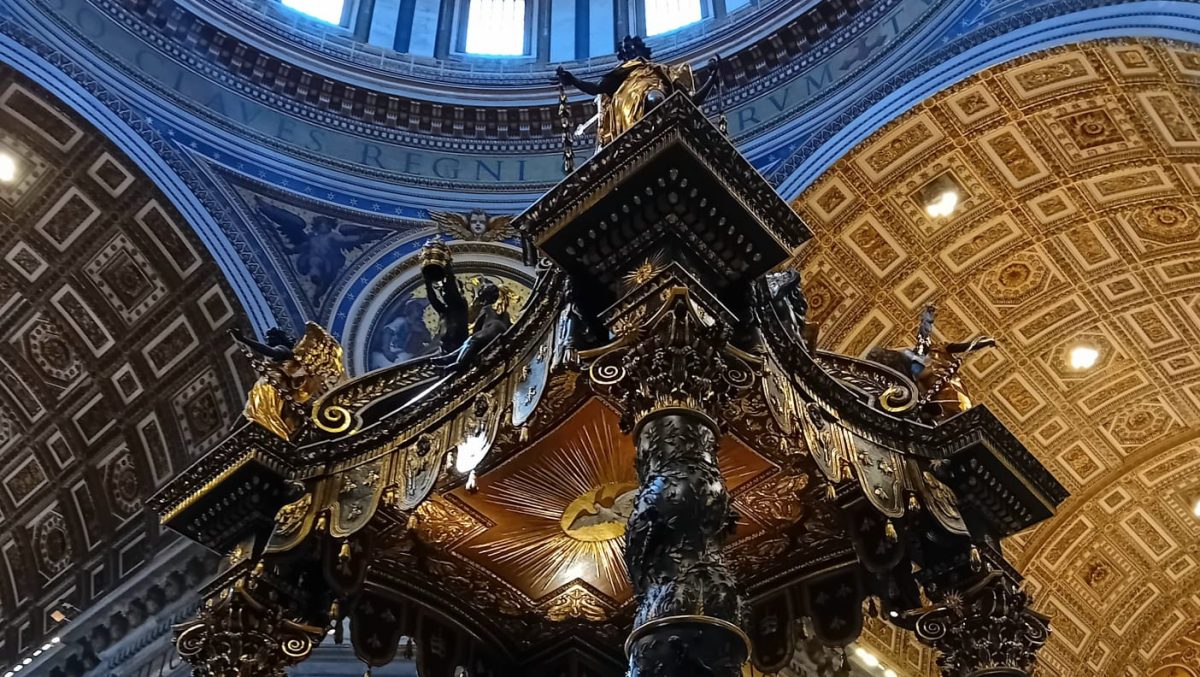
Four months into his papacy, on 13 September 2025, Pope Leo XIV hosted the ‘Grace of the World’ concert. It included a mix of celebrity musicians such as John Legend, Pharrell Williams, Jelly Roll, and Andrea Bochelli, but some of the most prominent performances were by Voices of Fire, an American gospel choir formed by Pharrell Williams in 2020. The Pope followed this with the Christmas-time ‘Concert with the Poor’, where the first half featured original music by Italian priest and composer Marco Frisina, and the second featured Michael Bublé and his typical, big band style.
These two events are clear outliers when placed in the general history of Church music. Christian music began with Gregorian chant in the ninth and tenth centuries, sung to accompany the ordinary mass. The Protestant Reformation brought about major changes to this system and its influences. Martin Luther promoted congregational singing in the vernacular and composed chorales such as Ein Feste Burg. These chorales became the structural basis for subsequent church music, influencing composers such as Schütz, Buxtehude, and J. S. Bach. From Bach onwards, Christian themes were prominent in Western Classical music: Handel composed oratorios such as Messiah (1741); Mozart, Brahms, Verdi and others all composed settings to Requiems; and Beethoven composed his famous Missa Solemnis in 1823. In England, the Reformation produced the Book of Common Prayer (1549), establishing a vernacular liturgy. This led to distinct forms of Anglican choral music – anthems, canticles, and service settings – by composers such as Tallis, Byrd, Gibbons, and, later in the 19th century, Stanford, Parry and Howells, whose works remain a staple of Anglican worship.
The twentieth century saw an extension of this use of vernacular language into music. There was a proliferation of styles, from Gospel music to Contemporary Christian Music (CCM) with its prominent rock, pop and folk influences. These forms of Christian music, however, have remained largely within their distinct denominations. Gospel music is closely associated with the Pentecostal and Evangelical denominations, while CCM primarily emerged in the Baptist, Reformed and non-denominational branches of Protestant Christianity.
Within this short history, we can see a general trend. While Catholic and Lutheran traditions seem to differ in many respects, Catholic, Lutheran, and especially Anglican musical traditions remain prominent. They almost represent a sense of immutability and ‘high art’. This can be explained for a couple of reasons – they’re major denominations within Christianity, they’re manifested in many other musical products within Western culture, and both the denomination and its traditions have been established for a longer period of time. Gospel music and CCM, while seemingly influenced by Lutheran emphasis on the vernacular, seem to be used more within other branches outside this ‘mainstream’. However in Pope Leo’s first two concerts, he seems to emphasise exactly those forms of Christian music that have traditionally been less prominent within the Catholic Church.
This raises the question: what does this new musical direction mean for the Catholic Church? I believe this is an intentional redefinition of what makes ‘good’, canonical music in the Christian tradition, a redefinition according to the current vernacular. In contemporary society, ‘mainstream’ music is defined by genres like pop, rock, and R&B. The Catholic Church, in following this example, promotes their closest manifestations within the Christian tradition: Gospel and CCM. The result is a deconstruction of the timeless canonic aura that Catholic, Lutheran and Anglican church music has acquired, replacing it with a model that prioritises accessibility and contemporary relevance.
On examining the two concert programmes, the ‘Grace of the World’ and the ‘Concert with the Poor’, we see this shift occur through an accommodation of secular culture within a religious setting. In the Grace of the World concert, Andrea Bochelli performed the hymn Amazing Grace with Teddy Swims, known for his soul, pop and R&B music. It thus acts to bridge the gap between pop fandom and religion. The concert also includes mainstream pop songs that have no explicit religious content, sung by their original artists. It suggests an accommodation where the experience of joy becomes sacred, rather than just the text itself. The concert becomes a celebration of love and community, blessed by the religious setting – Pharrell Williams performs his pop song Happy, for example, where this feeling becomes a spiritual experience. In the ‘Concert with the Poor’, Michael Bublé sings Beginning to Look a Lot Like Christmas, a commercial Christmas song. Its inclusion alongside the hymn Silent Night blurs the line between the celebration of Christmas as a cultural holiday and a sacred one.
We also see a ‘Gospel-ification’ in music, particularly within the ‘Grace of the World’ concert. Gospel music occupies a prominent position, with the majority of the songs performed either falling within the genre or adopting its style. The most notable performances came from Voices of Fire, who performed tracks including Anywhere, Miracle Worker, Business, and Joy. Beyond this, performers also included songs that are not traditionally gospel but still carry its characteristic communal and emotional emphasis; for example, Jelly Roll and Jennifer Hudson delivered a rendition of Hard Fought Hallelujah, and Michael Bublé performed Feeling Good. Though arranged in a big band style, the latter song’s themes of liberation resonated strongly with gospel music’s typical expressive arc and its sense of uplift, declaration and freedom.
Finally, we see a trend in the ‘Concert with the Poor’ where jazz influences are treated almost as their own contemporary hymns. The concert opens with ‘traditional’ religious pieces by Marco Frisina (Tu sei Pietro, Puer natus est nobis), establishing a reverent atmosphere. But when Frisina’s set ends and Michael Bublé’s begins, the mood is extended rather than broken as Bublé’s jazz style becomes a continuation of worship. After Frisina’s Gloria in Cielo, the programme moves to The First Noel before transitioning into Feeling Good. This might appear jarring, but here it acts as a reflective, personal expression – a ‘hymn of the self’ offered in a sacred space. Though not explicitly religious, Bublé’s songs and their lyrics of love and reflection are reinterpreted as spiritual themes, especially when placed in such close proximity to Frisina’s music. Bring It on Home to Me, with its themes of return and redemption, is recontextualised as a prayer for spiritual homecoming when accompanied by the choir and orchestra. Always on My Mind, framed within the sacred context of the concert, is reinterpreted as an expression of divine, rather than romantic, devotion – a confession of human inadequacy before God, accompanied by the choir’s responses that transform gravitas into worship.
Across both concerts, then, the sacred is no longer defined by liturgical texts or historical forms, but by the intention and context of the performance itself – a fundamental shift in how the Church now chooses to sanctify music. What remains certain is that music has capacity beyond the sound it makes. Music is not only an innate expression of the individual but also an entity with powerful cultural significance. It is no wonder that Christianity has utilised it, nor is it any wonder that the Catholic Church is reassessing the music it promotes. By embracing gospel, pop and jazz within sacred spaces, the Church signals an understanding that to culturally galvanise what Benedict Anderson (1983) calls the ‘sacred imagined community’, it must speak in the vernacular of the age. This does not translate into an abandonment of tradition but an expansion of what constitutes canonical music within Christian tradition. In doing so, the Church repositions itself not as a curator of a fixed musical canon, but as a participant in the living, evolving language of contemporary faith.