
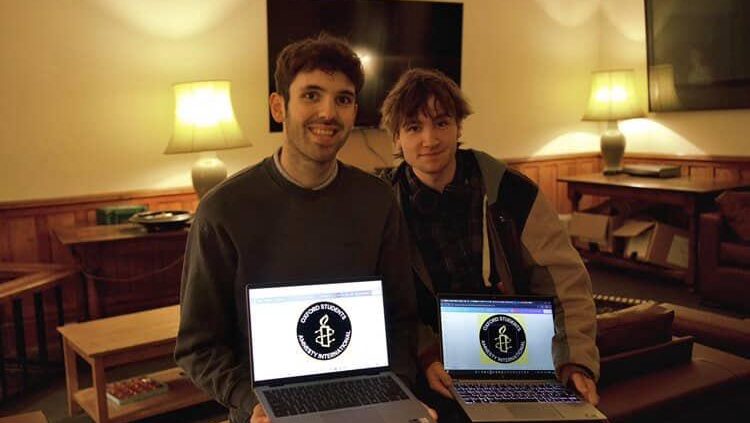
Hopelessness appears to be a common feeling in today’s political climate. Yet co-founders of the new Oxford Students Amnesty International society, Seth Olner and Ned Remington, emphasise the continuing power of human rights advocacy. “Expressions of solidarity, however small they might seem, can reach across the world”, Olner told The Oxford Blue. Even in times when the world is not listening, “it’s the candle; it’s the light”. It is, they say, “solidarity”.
The society’s first event is set for 6 March 2026, a relatively casual meeting before a hopefully busy Trinity Term. In the meantime, Olner and Remington spoke to the Blue on what motivated them to found the society, what human rights advocacy can look like, and the state of human rights today.
Amnesty International is a human rights organisation, which seeks to “fight abuses of human rights worldwide”. Olner has previous experience with the group, having joined at around the age of fourteen. He said the experience gave him his “voice”. For Remington, this is his first proper experience with the organisation, driven by insights he gained through working on human rights issues during a gap year. He collaborated with human rights lawyers on anti-death penalty activism in the US, worked on the issue of torture at CIA ‘Black sites’, and more.
Although there was previously an Oxford Amnesty International Society, it has not been operational since 2023. Remington emphasised that this is a “fresh start for Amnesty in Oxford”. Right now, the pair’s main aim is to bring the society into existence. However, in the long term, they said they want to see the society become “active” and “recognised”. They want to incorporate Oxford Brookes students alongside University of Oxford students. The society will work on topics affecting the University of Oxford, but also domestic and international issues. With its diverse student body, Remington said that Oxford has the potential “to raise the next generation of human rights advocates”.

Both Olner and Remington recognised the range of human rights crises today. Remington called today’s situation a “polycrisis”. We are facing dozens of human rights issues, which would, in another time, “each be dominating the news 24/7”, he argued. From the treatment of Uyghur Muslims in Xinjiang, to ICE’s human rights abuses in the USA, to genocide in Gaza, Remington attested to a global, “creeping authoritarianism”.
Still, “everyone”, said Olner, has their “get-out-of-bed in the morning cause”. For him, right now, this is refugee rights. “It’s terrifying right? Absolutely terrifying”, he said, referencing the current Labour government’s stance on asylum seekers and the rise of right-wing political parties, such as Reform UK. In his view, “fascism is knocking at the door”. Remington also added that he was particularly concerned about free speech being under threat and a lowered respect for human rights protections across the world. Now, “supposedly liberal democracies, no longer seem to value equal treatment under the law”. Fighting for these freedoms, he said, is not an “extreme view”, and should be something that both the political left and political right can agree on.
Discussing what the society aims to offer, Olner stressed the “existing human rights oriented community in Oxford”, which they are not trying to compete with. Indeed they want to work with groups like STAR (Student Action for Refugees), ‘Hotmess’, the Oxford Human Rights Student Society, and anyone else who shares their values and goals. Still, they argue Amnesty has the advantage of being holistic rather than single-issue focused: it can become a “focal point of human rights activism”.
The pair pointed to multiple, potential avenues for activism. From marches and protests, to letter writing campaigns, human rights advocacy often involves getting in touch with “decision makers” and applying pressure. Nevertheless, Remington acknowledged people’s immediate question on international issues is often, “well what can I do?” Iran has recently witnessed large-scale state violence against protestors, with U.S. based Human Rights Activists News Agency (HRANA) saying it has confirmed over 6000 people killed. Remington highlighted the importance of awareness campaigns here, in conjunction with showing support for dissidents from Iran, now in the UK, who have escaped “barbaric” treatment by the Iranian government.
Both referenced a crackdown on the right to protest in the UK. Asked whether a society like theirs is under threat due to this, Olner said, “yes… probably”. Some of his earliest memories with Amnesty were in the aftermath of The Police, Crime, Sentencing and Courts Act 2022, and The Public Order Act 2023. In the present day, he pointed to the Labour government’s proscription of Palestine Action as a terrorist group. This is “fundamentally a free speech issue”, he said. Amnesty International have been involved in the judicial fight against the proscription. In the high court’s ruling, the proscription was found “disproportionate”, but the current Home Secretary Shabana Mahmood said she was “dissappointed” and plans to appeal the decision.
Amnesty has concluded that since Hamas’ attacks in southern Israel on 7 October 2023, Israel has been committing genocide against the Palestinian population in the Gaza Strip. Earlier than this, in February 2022, Amnesty found Israel to be guilty of the crime of apartheid against Palestinians. The pair emphasised that Palestine has always been a key cause for Amnesty, and that they will continue to fight for it. Olner underlined that Palestine Action’s proscription was, however, a completely different issue. Amnesty, Remington said, is not just campaigning against the group’s proscription because it consists of pro-Palestine advocates, but because Amnesty fights to protect everyone’s right to peaceful protest.
The upcoming event on 6 March, Olner said, is intended as “a big embrace to Oxford”. People are encouraged to bring causes, challenges, and ideas. He stressed, it is not a formal “meeting”, and is taking place in a pub, The King’s Arms. They aim to bring together people who are human-rights-oriented or keen to get involved. There will also be petitions there and speeches related to them.
Next term, the society is hoping to have a “fully-fledged term card”. This will aim to include speaker events, campaign events, and protests, collaborating with other groups. Alongside this, Olner and Remington are hoping to run socials too. Remington alluded to the “infamous Jamnesty events” at other universities. For now though, he added, “6 March at 7pm … Be there or be square”.