
Nancy Gittus
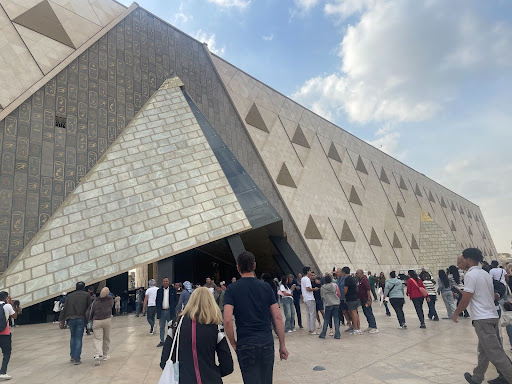
It certainly is an impressive sight. Enormous pyramidal glass panels line the outside of the Grand Egyptian Museum (GEM), a site spanning 500,000 square metres. Inside, visitors are greeted by a gigantic, striding statue of Pharaoh Rameses II, often referred to as the “Great Builder of Egypt”. The Grand Central Staircase, lined with 60 of the site’s most impressive monuments, leads up to a world-class view of the Great Pyramids of Giza. If you turn left at this point, you enter 12 galleries, all packed with artefacts ranging from pre-history to Roman rule. If you turn right, you re-trace Howard Carter’s steps as he discovered the burial chambers which housed Tutankhamun and his great treasure trove – whose artefacts have now been reunited for the first time since the tomb was opened in 1922.
This project has been 20 years in the making. Construction, which started in 2005, has been repeatedly stalled by funding shortages and political instability, earning GEM the nickname ‘the museum that never opens’. Initially supposed to open its doors in 2013, the museum finally made its debut on 1 November 2025, in what came to be one of the biggest cultural events in Egypt’s recent history. Every Egyptian phone even had the name of their network service provider replaced with the line ‘Egypt is proud – GEM’ or ‘Egyptian and proud’, and the list of invitees to the opening night sparkled with the names of officials and heads of state from over 60 countries.
Egypt is a country grappling with inflation rates of 12.5%. There are only 1.13 hospital beds per thousand people and it faces severe over-crowding in classrooms. There are as many as 120 students to a room in some areas. As such, it might seem strange that President Al-Sissi would choose to invest $100 million in a museum. In fact, the project cost $1 billion, but $800 million was provided by Japan, and a further $100 million was contributed through public funding. It serves as a true testament to the international collaboration which brought about the existence of Egypt’s national GEM.
However, this cosmopolitan opening night is perhaps the key to understanding President Al-Sissi’s aims and ambitions in the construction of the GEM: as former antiquities minister Khaled El-Enany said, “This is a gift from Egypt to the whole world”.
“The GEM will reshape Egypt’s tourism map, especially in Cairo,” Al-Sissi declared, and continued, ‘“its impact on the country’s tourism industry and economy will be profound”. The construction of this museum, the largest ever dedicated to a single civilisation, is not just about celebrating Egyptian heritage and culture – it is about monetising it too. The hope is that the GEM will promote tourism, which, comprising 9% of the country’s GDP, is not an insignificant contributor to the Egyptian treasury. New infrastructure has even been built to support the museum, such as a new airport close to Giza, ensuring smooth and efficient visits. Minister of Planning Rania Al-Mashat said that Egypt’s goal is to attract 30 million tourists by 2030, which would double last year’s figure of 15 million (2025). She added, “The tourism sector is one of the sectors with the highest employment multiplier, where every direct job opportunity in the sector creates two to three indirect job opportunities, which reflects the great importance of the sector in the Egyptian labour market”. As Antiquities Ministry Official Ahmed Zain Abdel Rahman phrased it, the GEM “means jobs, it means money, it means stability, it means a better life for every Egyptian”.
The GEM also provides an opportunity for Egypt to emphasise its place at the heart of Egyptological studies, providing the country’s scholars with a world class venue in which to host international events. Sara Abdelaziz, head of communications at the American Research Centre in Egypt, believes that, “the Museum can serve as a hub for international collaboration with Egypt’s egyptological scientific community through conferences, joint publications, and shared exhibitions, fostering growth in the discipline”. Professor Salima Ikram built on this in an interview I conducted with her for The Oxford Blue, during which the distinguished university professor stated that, ‘‘There are collaborations in the work with different universities and museums” and she thinks “that there will be intellectual exchanges, as well as training programmes”.
The museum might also serve to fuel campaigns to return certain key artefacts to their Egyptian homeland. In 2022, the Netherlands returned a 3,500 year old stone head from the dynasty of Thutmose III, however there remain many other highly valuable Egyptian monuments distributed across Europe. As the museum is equipped with state of the art technology, such as Goppion cases, which are airtight and fitted with microclimate control and anti-vibration systems, Egypt can now defy claims that artefacts must remain in more developed countries to ensure their conservation. Former Minister of Antiquities Dr Zahi Hawass is leading a campaign for the return of certain key artefacts which hold great cultural significance. “The specific objects I am fighting for are The Rosetta Stone in the British Museum, the Dendera Zodiac in le Louvre, and the bust of Nefertiti in the Staatliche Museeen zu Berlin” he says, emphasising, “our mission is to see these scattered relics returned, not just for Egypt, but for humanity’s understanding of its shared heritage […] each case, each artifact, embodies a chapter of Egypt’s long and luminous narrative”.
The return of these monumentally important historical artefacts would give many a sense of justice and pride. As archeologist Monica Hanna says, “the Rosetta stone is the icon of Egyptian identity” and “today this is the people demanding their own culture back”. GEM represents a step towards achieving that. Professor Ikram further stated that, “‘The opening ceremony was something that was a great cause for national celebration and unification […] it also brings the past more closely into the present, and gives the Egyptian people, as a whole, a sense of pride and accomplishment”.
Taken altogether, it is clear that the GEM is all about the international. The international collaboration by which it was brought about, the global tourism it is hoping to engender, the repatriation of artefacts from abroad, and the worldwide scholarly exchange it can facilitate. From its opening night to the millions of tourists visiting the site years from now, the GEM stands as a symbol of Egypt’s ambition to assert its status as a protagonist in contemporary global affairs.
Ahmed Kandil, Head of International Relations Unit and Energy Programme at Al-Ahram Centre for Political and Strategic Studies, stated that, “GEM is a narrative intervention”. He stresses that “ownership, in this context, is inseparable from the right to narrate history […]. GEM is not only a showcase of antiquities; it is an assertion of Egypt’s authority over its own narrative”.
By honouring its past with such substantial investment, Egypt is asserting control over its history and identity. Professor Ikram emphasises that the GEM “is a reclaiming of one’s history and art as well as establishing equality if not dominancy over the field”. By piling on the pressure for the return of artefacts, the GEM acts as a silent and yet eminently powerful challenge to the old imperial order, and the dominance of the West in global affairs.
It symbolises Al-Sissi’s push towards a more multivocal, multicultural international stage of power – which has been an increasingly visible ambition of his over the past few years. He has called for a restructuring of the UN Security Council in order to promote African voices in global decision-making, and has argued for a “more pluralistic” world order. The GEM embodies this push for a visible and influential Egypt in international networks of power and decision making. The state of the art facilities and the diverse invitees at the opening night stress President Al-Sissi’s ambition to have the GEM regarded as “the fruit of a global partnership and a tribute to human civilisation”, marking Egypt as an active contributor to world affairs, not a passive observer.
This aim is exemplified by Egypt’s offer to host the Sharm El-Sheikh Peace Summit in October 2025, as well as its decision to join BRICS in 2024, and it is above all symbolised in the Grand Egyptian Museum. This museum is not just a walk through Egypt’s powerful past, rather it is a projection of the country’s bright future, an assertion of soft power, and an enhancement of their global presence. The Grand Egyptian Museum marks Egypt out as a key player on the global stage, not someone to be played.