
Nancy Gittus
The sun rises on a Sri Lankan paper making factory. Machines whir to life as workers stream through the doors. Wet pulp begins to be spread across a moving wire mesh, drying slowly into one large paper mat in the morning heat. But the pulp used by this particular manufacturer, in the small village of Randeniya, Sri Lanka, is not your average sort. It is not the usual, boring old woodchip stuff. This pulp is poo pulp. Elephant poo pulp, to be precise.
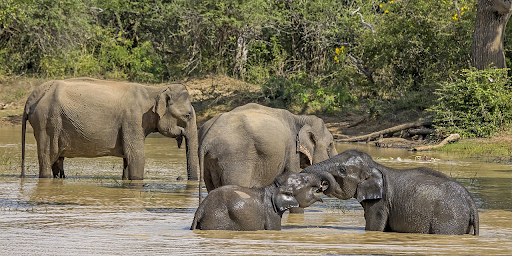
Today, there are around 40,000 to 50,000 Asian elephants left on the globe, and between 2,500 and 4,000 of these live in Sri Lanka. These mighty beasts are the largest and darkest of their Asian subspecies, and live in small matriarchal herds. Weighing between 4,400 and 12,000 pounds, and standing around 8 to 10ft at the shoulder, each of these mammals produces 180-200 kg of poo per day. It turns out, however, that this “waste” is not so rubbish after all.
Elephants subsist solely from vegetable matter. In Sri Lanka, they mostly consume bamboo, sugar cane, grass, and bananas. Crucially, however, they also have inefficient digestive systems which can only semi-digest the fibres they consume. This means their poo is able be re-processed. Boiling the fecal matter at a high temperature results in a segregation of these vegetable fibres, creating the equivalent of wood pulp. So yes, you can indeed buy notebooks, cards, pads, and envelopes all made out of elephant poo.
How and why has this come about? In 1997, Thusitha Ranasinghe wanted to push his family printing business in a more sustainable direction. He began to investigate the different ways he might be able to use recycled paper or plant fibres in his family firm. He then stumbled across a pilot project in the Mwaluganje Elephant Sanctuary in Kenya, which had begun in 1994, with the aim of making paper out of elephant dung. Taking inspiration from this Kenyan experiment, Ranasinghe became the first man to commercialise elephant excretion. Although many (including his parents) thought he was crazy, Thusitha decided to set up his own business with the help of his sister and two friends. Thus, Eco Maximus was born. Starting with just seven employees, Eco Maximus has used its business to empower local communities and rural youth, and by 2009 it had almost 200 employees.
Since then other businesses have started up. The Mr Ellie Pooh Project is one such enterprise. Their home page summarises their ambitions well: Saving Elephants, Creating Jobs, Protecting Trees. Like Eco Maximus, they buy poo from local elephant sanctuaries and orphanages, turning waste into profit. This way they can produce sustainable paper, whilst also supporting Sri Lankan elephant conservation projects, and employing local people.
Between 33-40% of all industrial wood traded globally is used in the pulp and paper making industry. Making paper from poo, rather than wood chips, naturally reduces the number of trees which need to be cut down. Some estimate that companies like Eco Maximus have saved billions of trees from being axed. But the environmental benefits do not stop there. The whole elephant poo paper manufacturing process uses 44% less energy, and produces 38% less greenhouse emissions, 41% less particulate emissions, 50% less wastewater, and 49% less solid waste than its woody counterpart. This is because elephants already do half the work for us. Postdoctoral researcher Andreas Mautner phrases it well: “You need a lot of energy to grind wood down to make nanocellulse […] you can reduce the number of steps you need to perform, simply because the animal already chewed the plant and attacked it with acid and enzymes. You inexpensively produce a nanocellulose that has the same or even better properties than nanocellulose from wood, with lower energy and chemical consumption”. To add to all this environmental yumminess, some companies, such as Eco Maximus, choose not to use chemicals like bleach or chlorine for disinfection, but instead opt for margosa leaves. This means waste water will not be polluting, or toxic to the environment.
In many ways, Sri Lanka faces a heavy burden. Elephants present both a gift and a curse to a country for whom over 30% of the citizens are employed in the agricultural sector. As Sri Lankan elephant expert Prithiviraj Fernando explains, “All the food crops we cultivate are very attractive to them”. Human-elephant conflict is, therefore, an escalating problem in the area. A decade ago, Sri Lanka lost around 250 elephants a year, whereas in 2023 a record 470 elephants died. In the same year, around 170 people died in human-elephant encounters. This rise in fatalities is largely due to an increase in competition for land. In 2024, Sri Lanka lost 12 kilohectares of natural forest, the equivalent of 16,000 football pitches. As farms grow, space for both humans and elephants is becoming increasingly squeezed, and in turn elephant raids on crops and gardens are becoming more and more common. Although in Sri Lanka the consequence for killing an elephant is the death penalty, the damage elephants can wreak upon crops and farmland has led many farmers to take lethal action against them. This includes constructing electric fences with fatal voltages, poisoning them, shooting them, or employing particularly nasty “jaw bombs” – explosives hidden inside food baits that then detonate inside an elephant’s mouth.
Although developments are being made towards more humane defence mechanisms, such as constructing non-fatal electric fences around farms and communities, as Dr Prithiviraj Fernando warns, “we must learn to live together peacefully. If things continue as they are, up to 70% of Sri Lanka’s elephants will be lost.”
This peace is exactly what Dr Karl Wald, founder of the Mr. Ellie Pooh Project, and Thusitha Ranasinghe, are trying to achieve. Working in tandem, both men are striving to prove that elephants can be an asset. They hope that by demonstrating the financial value of elephant faeces in providing work to rural communities and youth, stimulating the economy, and preserving natural resources, their work will encourage fellow Sri Lankans to consider elephants as a gift, not a burden. Mr Ellie Pooh is also attempting to raise tolerance among farmers by compensating them for the damage to their crops with the profits made from the paper making business. In this way, Wald and Ranasinghe hope to put an end to the violence. They are working to protect elephants, trees, and employment for generations to come, to create a world where the inhabitants of Sri Lanka, man or beast, can live together in harmony.