


Heidi Morstang, filmmaker, visual artist and associate professor at the University of Plymouth, recently screened her award-winning film 47°C at Christ Church, Oxford. In the past, her work has explored the cultural and ecological significance of landscape, engaging with themes of environmental change. The new documentary-style film follows Camille Parmesan and Michael C. Singer, two world-leading ecologists as they conduct fieldwork in Sierra Nevada, California.
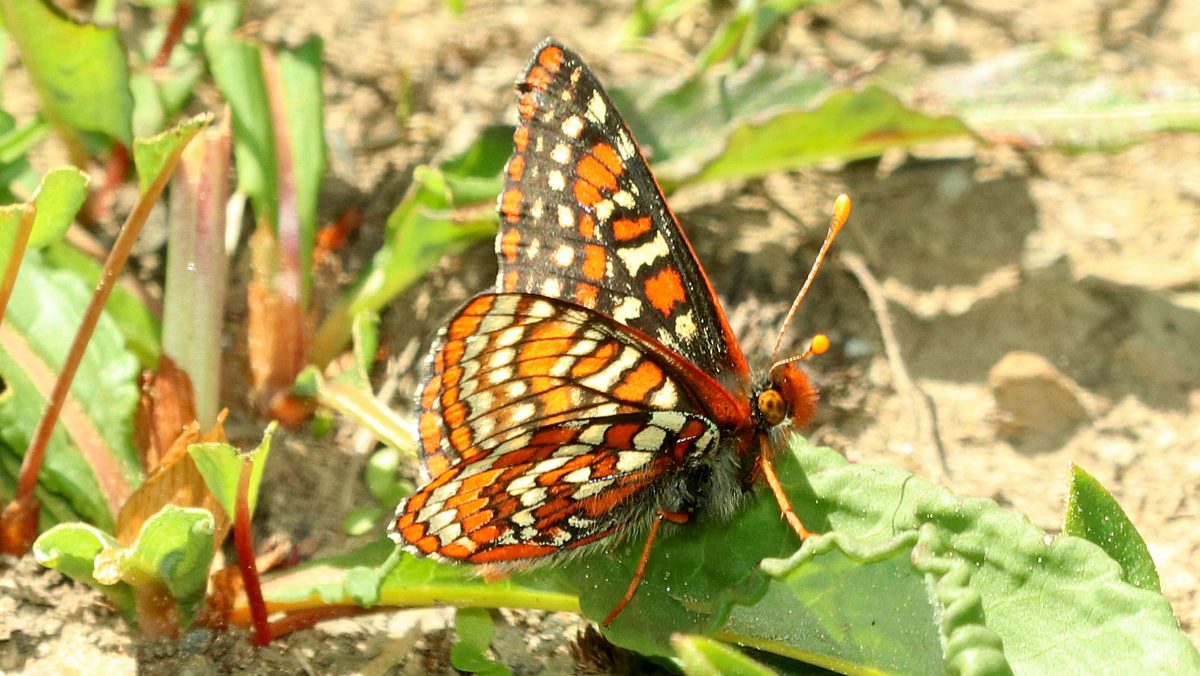
The film, which was awarded the Jury Prize in the Moving Creatures programme at Mimesis Documentary Film Festival 2024, observes the two scientists as they conduct fieldwork on the ecology and evolution of the Edith’s Checkerspot butterfly, a species they have researched since 1968. Allowing the viewer an intimate glimpse into their lifetime dedication to this species and this study, the documentary is narrated through Parmesan and Singer’s investigations and discoveries throughout the fieldwork process.
In a Q&A following the screening, Morstang described how the pair demonstrated years of knowledge of the environment in the way that they discuss and move through it. In fact, the way that Morstang frames the researchers and the landscape equates the two, bringing the landscape itself into focus as a main character in the film in its own right.
Whilst it is not yet classified by the IUCN Red List (like many invertebrate species), the U.S. Fish and Wildlife Service has designated the Edith’s Checkerspot as an endangered species, due to its particular vulnerability to a changing climate. Populations of the species mirror changes in climate over long periods of time. As global warming shifts the climatic conditions of the habitats these butterflies depend on, their risk of extinction rises sharply. However, this problem extends beyond the Edith’s Checkerspot. If global temperatures exceed 1.5°C, as they are increasingly likely to do, extinctions will accelerate rapidly across all species, and under the highest emission scenarios, one-third of species globally are estimated to be threatened by extinction. Therefore, the vulnerable insect we are presented with almost acts as a microcosm for global climate change and extinction patterns.
In this way, the film does important work to contextualise the impacts of climate change. By localising climate change impacts to one area, to one species, and to the pair of researchers studying it, the threats to our wildlife become more tangible and real. Equally, unlike most academic work on climate change science, technical jargon-filled articles and lengthy reports, the format of Morstang’s work is accessible, conveying the most important messages about climate change: that it is real, human-caused, serious, and solvable.
By using the creative form of film-making to communicate climate science, or other environmental issues, to a wider audience, is not only a fascinating tool in the environmental effort, bringing to mind the likes of Attenborough’s ‘Blue Planet’, but also an insight into the intersection of creative and scientific ways of working. Morstang’s project, at the intersection of creativity and academia, reminds us that meaningful scientific communication cannot solely rely on data, but needs to make the consequences of climate change impossible to ignore.