


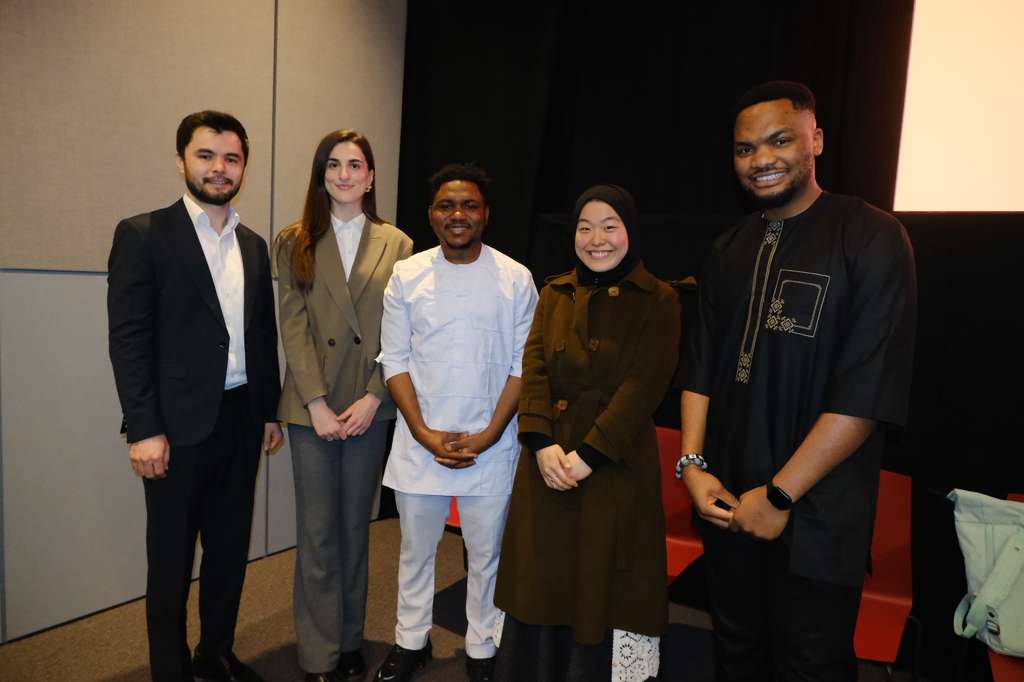
On Wednesday 25 February, the Oxford University Students’ Union organised a session of its Postgraduate Storytelling Series, titled ‘Journeys of Hope: The International Student Experience and the Making of Global Scholars’, at the Schwarzman Centre. The event, moderated by Oxford SU’s President for Postgraduates Wantoe T. Wantoe, featured four international postgraduate students, described by Wantoe as “leading incredible change across Oxford”: Ikboljon Sabirov, Great Nnamani, Shixin Zhao, and Doruntina Aruqaj.
The audience first heard from each of the speakers. Sabirov, currently a DPhil researcher in Medical AI, described how he received a full scholarship to study medical sciences and AI at undergraduate level in Uzbekistan, only to discover that his university did not link him to what he described as the “global research arena”. When he realised that he would not be able to fulfil his ambitions there, he moved to the United Arab Emirates to pursue a Master’s Degree on a Graduate Fellowship, which allowed him to enter “one of the most competitive fields in the world regarding AI”. During his time there, he authored a US patent and research papers before moving to Oxford to pursue his DPhil, focused on advancing cardiovascular medicine (obtaining transcriptomics data) through AI. He revealed how he initially struggled with self-doubt after arriving at Oxford before eventually realising how “the spaces we enter do not define us—their value is from the people that step into them”. This drove him to begin mentoring younger students from similar backgrounds to his own, an experience that helped him realise that attending Oxford did not mean “leaving your origins behind but building bridges between them.” To close his speech, he urged the audience to question themselves consistently as to how their presence could help shape the University.
Sabirov was followed by Nnamani, who is pursuing an MPhil in Economics as an Oxford Cyril and Phillis Long Scholar, while also being the founder of the African Economic Scholars Programme. He revealed the struggles he faced when he first arrived in the United Kingdom to pursue higher education at Cambridge: on his first day there, he remembered a porter telling him, “You speak good English.” This prompted him to think about his accent for the first time. He recalled being surprised by one particular cultural difference between the UK and his home country: unlike in the latter, people in the UK frequently smiled at one another as they passed each other in the streets, which led him to wonder whether he would be considered rude for not doing so. He remained there for approximately a year before receiving a scholarship to The Queen’s College at Oxford. He discussed how he initially struggled at Oxford, particularly due to the depth of knowledge which it demanded from its students. His struggles were not only academic: he recalled how the only two empty seats in a classroom would often be the ones next to him. He urged the audience never to let anyone make them feel as if they did not belong at the University, and to help overcome differences by promoting understanding and love.
Zhao, who is studying an MPhil in Development Studies, spoke next. She described her diverse experiences as an international student, having left her home in Mongolia at the age of fourteen to attend an international high school on a scholarship. She discussed the inherent paradoxes that accompanied such an experience. Despite having one of the highest GPAs, she recalled how her teachers were especially strict towards her since, if she did not receive admission to a prestigious university, the “school’s investment would be wasted”. She eventually attended the University of Chicago to pursue her undergraduate degree, before encountering other experiences, including, trekking a hill in rural Indonesia and teaching English to offenders housed in a detention centre in rural California. She described how, despite all this, she could not escape the feeling that she wanted something more from academia, which drove her to attend Oxford, an experience which she described as fundamentally transforming the way she thought. This began when she submitted her first essay, about the persisting impact of colonisation on the Global South, only to be told by her professor that she wrote in a “polemical” style. This drove her to realise the need to understand the nuance with which different people engaged with the lasting impact of colonial ideas on globalisation, since the world was “not black and white”.
Aruqaj, who is pursuing an MPhil in European Politics at St Edmund’s Hall, was the last to speak. She recalled how she struggled to escape the feeling that she was trapped between two worlds. Her experience of speaking Albanian at home with her parents, who were Kosovan refugees and listening to Albanian news channels, led her to feel as if there was “one world at home (and) another…at school”. Her parents had consistently instilled the need to use her abilities to make an impact in Kosovo, which motivated her to apply for an internship in the Ministry of Justice, which took her there. To her dismay, she was perceived as a foreigner, with native Kosovans telling her how her British accent and consistent use of thank yous indicated that she was a foreigner. This helped her realise that she could embrace both aspects of her heritage – inspiring her to form an Albanian Society at Oxford to celebrate her heritage. She recalled the difficulties in attracting the minimum number of thirty members needed for a society, which she overcame by allowing anyone from an underrepresented background to join. This helped her understand how “leadership was about creating something for other people”.
After this, the audience was invited to ask the speakers questions. When asked how Oxford could better support them, the majority were unanimous that the University had provided them with extensive support, but there was still some room for improvement, especially regarding the need to improve funding. When asked how they managed to achieve a balance between immersing themselves at Oxford while retaining their own cultural inheritance, they spoke about the need to build a community of like-minded people amongst whom they would feel cherished. Great revealed that he achieved this through his cooking. To close the session, the panellists reiterated the need for people to help create an atmosphere of tolerance and friendship.