


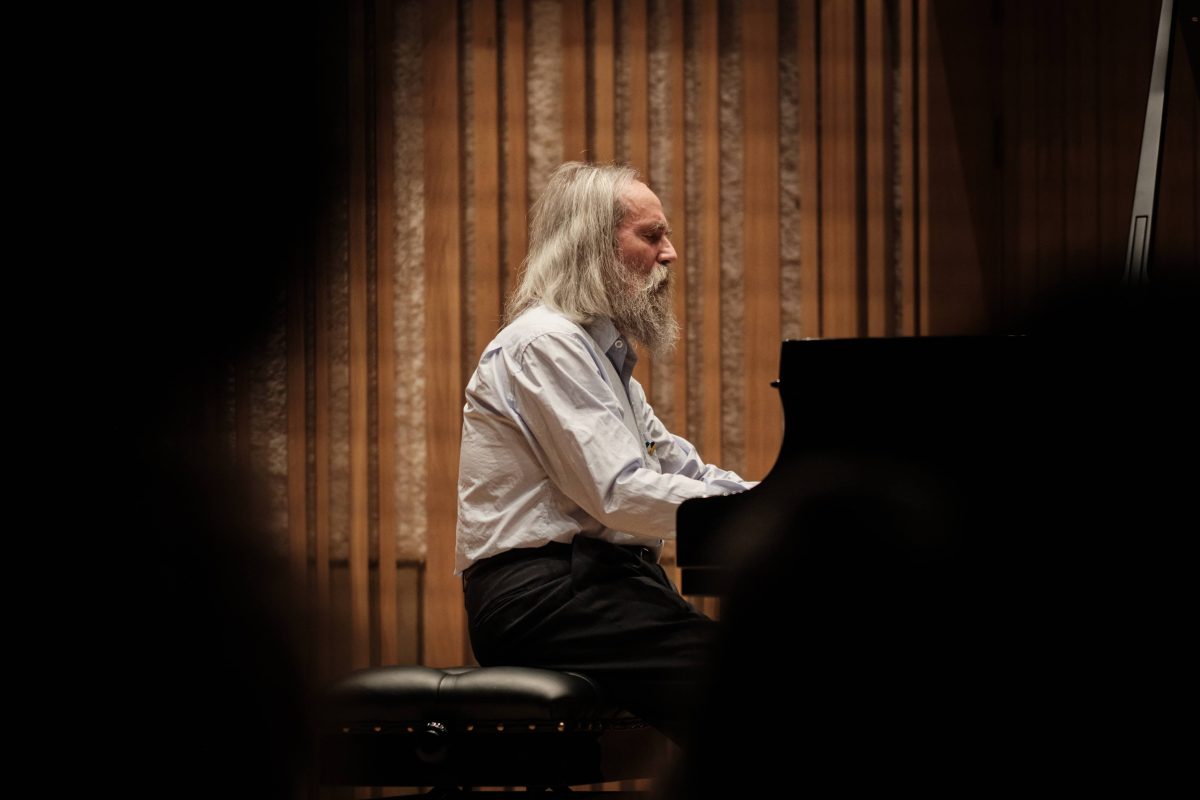
Following his Return Concert Series in February of this year, Lubomyr Melnyk returned to Oxford to play one of his most thought-provoking pieces. Windmills in concert at Exeter College Chapel saw Melnyk not only captivate and astound his audience but remind us too of the charm and humanity of a man who plays so mechanically, so reflexively.
Melnyk has already played in numerous college chapels (including Magdalen and Oriel) as well as The New Space, yet it is Exeter College Chapel, with its larger capacity and ornate interior, that feels like the grandest venue in the line-up thus far. For a music that is so sacred, touching on the divine, a chapel is the obvious setting. For Melnyk, music, and especially the practice of piano playing, is devotional, allowing both himself and the audience to feel a part of something greater than our immediate selves. His devotion to his craft is refreshing, something he believes is no longer possible, or is at least overwhelmingly rare, in the face of the concentration-epidemic brought about by the phone, as he tells his audience with such vigour and passion before the concert begins.
Despite the almost overwhelming grandeur of such a building, Melnyk isn’t a character who shrinks – in fact, these speeches, though taking many a digression, are always emphatically charged and well projected. He begins with a lengthy discussion of his anti-materialist doctrines, though perhaps undercut slightly by the ironies of being set in such an ornately decorated setting, almost entirely golden and stained-glass, the aisle to his instrument bedecked with electric candles. So too does it seem that his music must be geared to the material. Joking that as a retired hippie he has given our culture two things – granola and speakers – Melnyk’s focus on music’s materiality is largely tied to his project to create a sound that is undying. Urging his audience to purchase his CDs and vinyl, since they have a greater quality of sound, and to buy a cheap CD player from eBay, this idea of re-using coincides with much of Melnyk’s engagement with music. From his refashioning and drawing on the greats like Beethoven, and also the nature of continuous music, a genre that is dependent, even founded, on repetitions and echoes, such a sense of recurrence is only exacerbated in such a large, reflective space.
However, Melnyk’s musical performances go further than such concepts of re-using, re-playing or re-hearing. His music isn’t one that begins again, but seems to be constantly playing, in a perpetual state of beginning and growth. Though the concert was to celebrate Windmills, Melnyk begins the evening with Piece One, a broadly improvised piece he often uses as an introduction to his more complex songs. Piece One has been revised many a time, though it is not so much a revision, but a continuous elaboration on a theme – partially improvised, partially repeated. Having seen Piece One performed at The New Space, I was expecting to find the experience recognisable. However, the piece felt just as fresh as the first time I’d heard it performed, just as absorbing and meditative in its droning, echoey splendour, played by a man who seems to become one with his instrument.
Piece One is followed by an introduction to Windmills, an explanation of its meaning and inspiration, its intent to map the journey of a man to acceptance of death. And after a digression, not brief by any means, about David Lynch’s depictions of Hell in Twin Peaks, Melnyk sits to embark on Windmills. It is an undoubtedly dramatic piece, uncontainable and therefore greatly benefitting from its being played in such a large venue. It begins grounded, bassy, low and sinister; mechanical in a completely different way to the playing of Piece One. It has almost an industrial feel, as Melnyk flaunts his ability to make his audience sit in discomfort, to really concentrate on the sound. Over the course of around 20-minutes the piece transforms itself into something airy, high, light as though leaving this material world. Melnyk’s music may all be explained as having something of this same airy quality, existing between a solid and a liquid, ungraspable, evasive and constantly changing.
The piece builds and ascends upwards, across the keys and through the air until we too feel light, as though we are defying death. One may even go as far as to suggest audiences felt unified by a pleasure to accept finality as the song comes to a light close, accepting our ‘luck’ (as Melnyk phrases it in his Lynchian preface) to not be trapped in an eternal, backwards-facing hell. By the end of the piece, sustained chords and echoes become so light that it becomes almost impossible to know when and where the piece ends (that is, if it ever really does). Such an adept handling of delicate sound really invites the audience to engage with the musical experience, to dwell on the last lingering notes as they fade. They never quite seem to disappear, but still feel as though they’re in the room with you, the vibrations having moved the air and moved your senses. As pretentious as it sounds, something always feels different in the energy of the room, and in yourself, after seeing Melnyk perform, and it’s something that can only be understood by experiencing, not simply hearing, the music.
This seems to be an energy, or shared understanding, that really resonated with the audience at Exeter Chapel, with a full standing ovation being granted to Melnyk after the concert. It is not just by the end of the evening that you can recognise the deep impact Melnyk has on his listeners. The layout of Exeter Chapel and placement of the piano in the aisle created an intimate atmosphere that encouraged audience members to look at one another, observe each other’s responses and the way each member engages with the music. And with a full crowd, it was exciting to see how many people sat with eyes closed, in a meditative trance, whilst some glanced around the room as an aid to their thought, others simply watching the master at work. Melnyk’s music has the unique power of creating an experience that is at once isolating and introspective, as well as communal, shared and expansive. At a Lubomyr Melnyk concert, both he and his audience deify music, sound being the only non-material experience we may enjoy and all share.
Is there sound left when there is nobody there to play it? This seems to be a question that plagues audience members, as well as Melnyk, after each concert he plays. Nathan Adlam (a follower and supporter of Melnyk’s whom I spoke to following Melnyk’s performance at The New Space), is always cautious to stress Melnyk’s age, and his pre-emptive lament for the idea of his music being lost. Continuous music, Melnyk and Adlam have stressed, is a really valuable meditative and technical exercise, with both strongly recommending that anyone with an interest use Melnyk’s sheet music to keep the music alive. Continuous music is something worth pursuing – Melnyk’s music feels so special because the audience are made so aware of its temporality, of its ability to be exhausted. We are threatened by the loss of such a unique thing even as we are made aware of its ever-expanding, almost eternal nature. It is beautiful to see how passionate the community surrounding Melnyk are, swarming to him with questions, and also just how eager Melnyk and Adlam are to keep the tradition alive, giving hope yet for the continuation of continuous music.